The Grand Illusion: All In Your Head
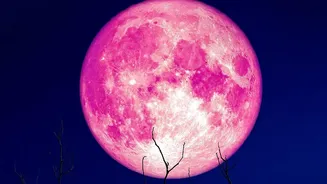
The most dramatic part of a horizon moonrise is its seemingly enormous size. Many people believe the Earth’s atmosphere acts like a magnifying glass, but the truth is far more fascinating: the size change is an optical illusion created entirely by your
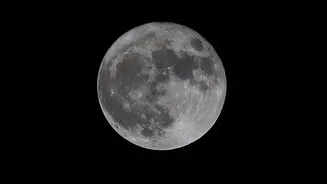
brain. Known as the Moon Illusion, this phenomenon has been documented since ancient times. Photographs prove that the Moon’s angular size—the space it takes up in your field of vision—remains constant whether it's on the horizon or high in the sky. So, why does it look bigger? The leading explanation is related to how our brains perceive distance. When the Moon is near the horizon, we see it alongside familiar objects like trees, buildings, and mountains. These objects provide depth cues, tricking our brain into thinking the Moon is much farther away than when it sits alone in the vast, empty expanse of the overhead sky.
Meet the Ponzo Illusion
This mental trickery is best explained by the Ponzo illusion. Imagine two identical lines drawn on a set of converging railway tracks. The line drawn where the tracks appear closer together (further away) will look longer than the one where the tracks are wider (closer up). Your brain, trying to compensate for the perceived distance, scales up the size of the 'farther' object. The same thing happens with the Moon. Because your brain interprets the horizon as being very far away, it assumes the Moon must be physically massive to appear the size it does, and thus you perceive it as huge. When the Moon is high in the sky, there are no reference points, so your brain defaults to a 'closer', and therefore smaller, perception. You can even break the illusion yourself: try bending over and looking at the horizon moon upside down through your legs. Without the familiar context, it will likely shrink back to its normal size.
An Atmospheric Paintbrush
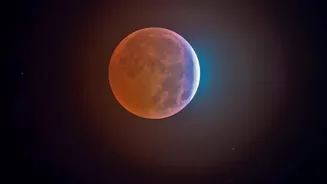
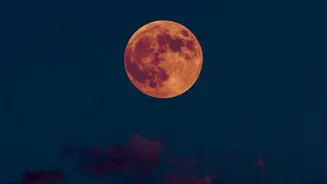
While the size change is a psychological trick, the dramatic colour shift from white to yellow, orange, or even deep red is a very real physical effect caused by Earth’s atmosphere. The light we see from the Moon is simply reflected sunlight. When the Moon is low on the horizon, its light must travel through a much thicker slice of our atmosphere to reach our eyes compared to when it's overhead. This long journey through the air acts like a filter. The atmosphere scatters shorter wavelengths of light—like blues and greens—in all directions. This phenomenon is known as Rayleigh scattering, and it’s the same reason our sky is blue during the day. With the blue light filtered out, the longer wavelengths of red, orange, and yellow light are what predominantly pass through to create the warm, colourful glow of a rising moon or a setting sun.
A Spectacular Combination
It is the combination of these two separate effects—one a trick of the mind, the other a principle of physics—that makes a horizon moonrise so awe-inspiring. The potent psychological illusion of immense size is amplified by the striking, warm colours created by atmospheric scattering. A huge, pale white moon would be impressive, but a huge, deep orange moon feels otherworldly. The rich, fiery tones give the Moon a tangible presence that enhances the brain's faulty perception of its scale. Dust, smoke, or pollution in the air can intensify these colours, making the effect even more dramatic. So, while the giant size is an illusion, the beautiful colour palette is very real, and together they create one of nature’s most reliable and breathtaking shows.