



A Landmark Discovery in the Stars
In a breakthrough for exoplanet research, astronomers have confirmed the presence of water vapour on GJ 9827 d, a planet located 97 light-years away in the constellation Pisces. While water has been found on larger, gas-giant planets before, detecting
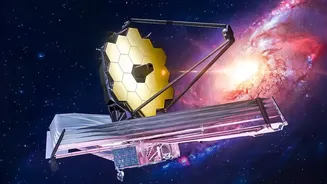
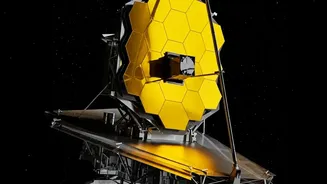
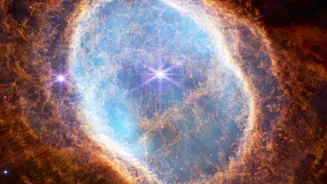
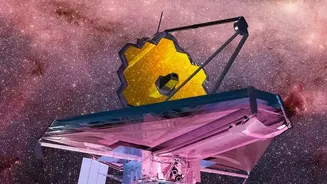
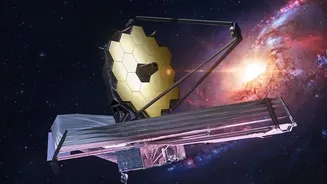
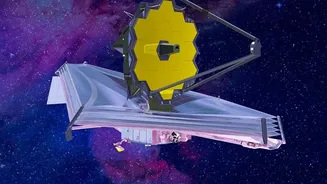
it on a world only twice the diameter of Earth is a landmark achievement. This finding, made possible by the unprecedented sensitivity of the JWST, pushes the boundaries of our ability to study potentially habitable worlds and confirms that planets with water-rich atmospheres exist around other stars. This discovery is a critical proof of concept, demonstrating that we have the technology to identify the building blocks of life on planets far beyond our solar system.
What Makes This Planet Special?
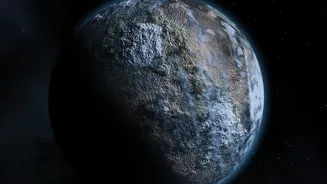
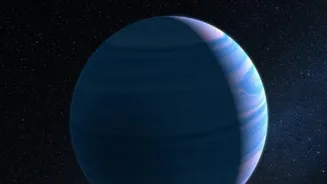
GJ 9827 d is classified as a "super-Earth," meaning it is more massive and larger than our planet but is still fundamentally rocky in nature, as opposed to being a gas giant like Jupiter. This distinction is crucial. While gas giants are interesting, the search for life as we know it is focused on terrestrial, or rocky, planets, as they offer the possibility of solid surfaces and liquid water oceans. The detection of water on GJ 9827 d makes it the smallest exoplanet to date with a confirmed atmospheric water signature, making it a prime target for further study. Scientists are now debating whether it is a hot, steamy world with a dense, water-rich atmosphere or a 'mini-Neptune' that is in the process of losing its primordial hydrogen atmosphere.
How JWST 'Sniffed' an Alien Atmosphere
The JWST didn't directly photograph clouds or oceans. Instead, it used a technique called transmission spectroscopy. As GJ 9827 d passed in front of its host star from our perspective, the telescope carefully analyzed the starlight that filtered through the planet's thin atmospheric rim. Different molecules in an atmosphere absorb specific wavelengths, or colours, of light, leaving behind a unique chemical fingerprint in the star's spectrum. In this case, JWST's instruments detected the unmistakable signature of water (H2O), allowing astronomers to determine that the planet is shrouded in a steamy haze. This method allows scientists to study the chemical makeup of worlds that are trillions of kilometres away.
Does Water Vapour Mean Life?
It's important to temper excitement with scientific reality: the presence of water vapour does not automatically mean the planet is habitable. GJ 9827 d orbits its star at a very close distance, completing a full year in just over six days. This proximity results in scorching surface temperatures of around 430 degrees Celsius, similar to Venus and hot enough to melt lead. At this temperature, any water would exist as a superheated steam, not liquid oceans. Therefore, GJ 9827 d is not a candidate for life as we know it. However, the discovery is less about this specific planet's habitability and more about what it represents: a major step towards finding a true Earth-like world.
A 'Steam World' Opens New Doors
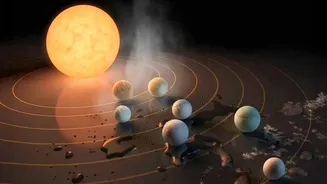
The finding has established GJ 9827 d as the first confirmed example of a long-theorized type of planet: a 'steam world'. These are planets with atmospheres dominated not by hydrogen, like gas giants, or nitrogen and oxygen, like Earth, but by water. Confirming their existence is a monumental achievement in itself. This discovery provides a natural laboratory for studying how such planets form and evolve. It also helps astronomers refine their models and techniques, which will be crucial when the JWST turns its gaze toward smaller, cooler, and potentially more Earth-like planets in the future. Each observation of a world like this brings us closer to answering the ultimate question.