




A New Look at an Old Friend
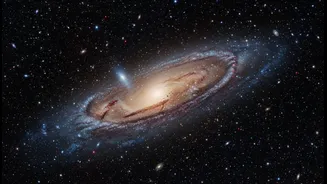
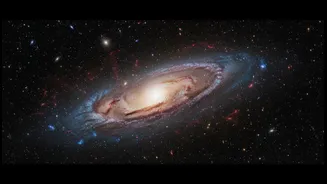
The new anniversary images focus on Centaurus A, a galaxy located a relatively close 11 million light-years from Earth. While it's one of the brightest and most studied galaxies in our night sky, much of it has remained a mystery. What makes Centaurus A so
intriguing to scientists is its peculiar structure and extreme activity, believed to be the result of a violent galactic collision about two billion years ago. At its heart lies a supermassive black hole that is actively feeding on surrounding gas and dust, blasting out powerful jets of energy that shape the entire galaxy. These features make it a perfect cosmic laboratory for understanding how galaxies and black holes evolve together.
Peering Through the Dust
Previous attempts to study the heart of Centaurus A with telescopes like Hubble were blocked by thick lanes of cosmic dust that obscure visible light. Other infrared telescopes, like the retired Spitzer, could see through the dust but lacked the power to resolve fine details. This is where the James Webb Space Telescope (JWST) changes the game. Its powerful near- and mid-infrared cameras can pierce through the obscuring dust clouds, revealing what lies beneath in unprecedented detail. The result is a stunningly clear view of the galaxy's core, transforming what was once a murky region into a vibrant landscape.
A Tapestry of Millions of Stars
What might look like photographic grain in Webb's new near-infrared image is actually a dense field of millions of individual stars. For the first time, astronomers can study these stars one by one, conducting a kind of galactic archaeology. Each star holds clues about the galaxy's history—from the formation of its oldest stars to a burst of star creation triggered by the ancient merger. By analyzing this stellar timeline, scientists can piece together a vivid record of Centaurus A's dramatic evolution, from its violent past to its active present.
Mysteries in the Dust
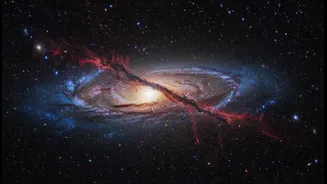
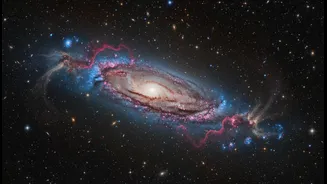
Beyond the stars, Webb's mid-infrared vision has highlighted the galaxy's intricate dust structures, which glow in surprising and perplexing shapes. A strange, warped parallelogram-like band cuts across the galaxy's center, and an unusual S-shaped feature has also captured astronomers' attention. The origins of these dusty structures are not yet understood. Scientists are now investigating whether they were created by the black hole's influence or are lingering effects of the merger-induced star formation that has shaped so much of the galaxy. These new questions demonstrate how Webb's observations are not just providing answers, but are opening up entirely new avenues of research.