


Sailing on Sunshine: The Science of Solar Sails
At its core, a solar sail works much like a ship's sail catching the wind, but in the vacuum of space, the 'wind' is sunlight itself. Sunlight is made of tiny particles called photons. While individually they have no mass, they carry momentum. When billions
upon billions of these photons bounce off a large, reflective, mirror-like surface, they transfer their momentum, creating a tiny but continuous push. This gentle, constant acceleration is called solar radiation pressure. Over weeks and months, this constant nudge can accelerate a spacecraft to tremendous speeds, all without carrying a single drop of heavy, expensive rocket fuel. This makes solar sails ideal for long-duration missions, enabling spacecraft to travel farther and for longer than ever before.
The Latest Leap Forward
The concept isn't new, but recent advancements are turning it from a promising theory into a viable workhorse for space exploration. A key breakthrough lies in the materials and deployment systems for the sails themselves. NASA's Advanced Composite Solar Sail System (ACS3) mission, for instance, has been testing novel, lightweight booms made from composite materials. These booms are designed to be tightly packed for launch and then reliably deploy a vast, thin sail in space. Another recent development involves a new contract awarded to the company Opterus to engineer a massive 1,600-square-meter sail, twenty times larger than the ACS3 sail, with a sophisticated system to control its shape for stable, consistent propulsion. Furthermore, researchers are developing nano-engineered sail materials that can better withstand intense heat when close to the sun, a major limiting factor for previous designs. These incremental, but crucial, advances in materials, deployment, and control are making solar sails larger, more robust, and more steerable than ever.
A New Toolkit for Asteroid Hunters
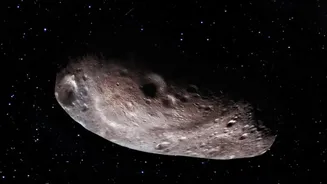
So why is this particularly exciting for studying Near-Earth Asteroids (NEAs)? NEAs are celestial bodies that orbit close to Earth, and while most are harmless, they represent a potential threat that requires careful monitoring. Traditional probes are limited by the fuel they can carry, making it difficult and expensive to chase down these fast-moving, and often small, objects. Solar sails solve this problem. A fuel-free probe can change its trajectory over time to match the orbit of an asteroid, get up close for detailed observation, and even potentially visit multiple targets on a single mission. This capability is vital for characterizing these small worlds. A mission like NASA's NEA Scout, which uses a solar sail, is designed to get close-up images of an asteroid smaller than a school bus, helping scientists understand if it's a solid boulder or a clump of rubble. This information is crucial not only for science but for developing effective planetary defense strategies.
Beyond Asteroids: The Future of Fuel-Free Flight
The implications of mature solar sail technology extend far beyond asteroid reconnaissance. The ability to achieve high speeds without propellant opens up the entire solar system. Missions that currently take many years, like journeys to the outer planets, could be completed in a fraction of the time. Advanced solar sails could also be used to create space weather early warning satellites, positioning them closer to the sun to give us earlier alerts about solar storms that can disrupt power grids and communications on Earth. Some researchers even envision fleets of tiny, low-cost solar sail probes that could be sent out to explore thousands of objects in our solar system, accelerating the pace of discovery. And looking further ahead, this technology is seen as a leading candidate for humanity's first true interstellar missions, propelling probes toward other star systems.