




A New Eye on the Cosmos
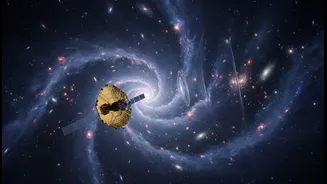
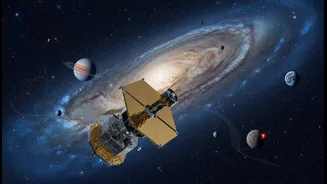
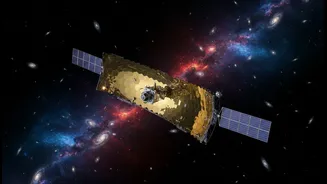
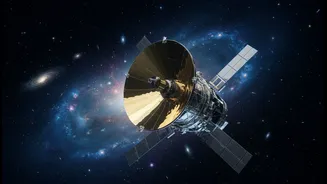
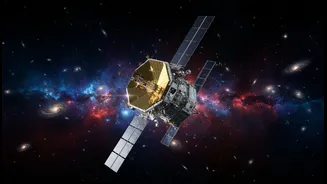
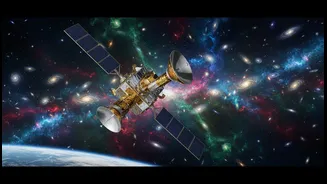
Set to launch by late 2026, the Nancy Grace Roman Space Telescope is NASA's next-generation observatory, designed to tackle some of the most profound questions in astrophysics. Named after NASA’s first chief of astronomy, the “Mother of Hubble,” this
mission aims to investigate the mysteries of dark energy and dark matter, discover new exoplanets, and conduct broad surveys of the infrared universe. Unlike its predecessors, which often focus on specific, narrow targets, Roman is built for speed and scale. It will survey the sky up to 1,000 times faster than the Hubble Space Telescope, generating enormous, high-quality datasets that will be publicly available, promising a legacy of discovery for decades to come.
The Power of a Panoramic View
Roman's primary advantage is its incredible field of view. While its 2.4-meter mirror is the same size as Hubble's, its Wide Field Instrument (WFI) can capture an area of the sky 100 times larger in a single snapshot. Imagine trying to piece together a massive puzzle by looking through a keyhole; that's been the challenge for telescopes like Hubble. Roman effectively replaces that keyhole with a massive bay window. This allows it to create vast cosmic maps with the same sharp resolution as Hubble but in a fraction of the time. What might take Hubble years to survey, Roman could accomplish in a matter of months, providing the crucial large-scale context for the deep, targeted observations of telescopes like the James Webb Space Telescope (JWST).
Charting the Invisible Universe
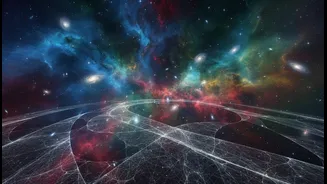
At the heart of Roman's mission is the High-Latitude Wide-Area Survey (HLWAS). Over its five-year primary mission, this program will map roughly 12% of the sky, capturing hundreds of millions of galaxies. The goal is not just to see these galaxies, but to measure their precise shapes and positions. By doing so, astronomers can map the distribution of dark matter—the invisible substance that makes up about 27% of the universe—by observing how its gravity subtly distorts the light from distant galaxies, a phenomenon called weak gravitational lensing. This will create the most detailed map of the universe's large-scale structure, often called the "cosmic web," revealing the filamentary network of dark matter along which galaxies and galaxy clusters are arranged.
Solving the Mystery of Dark Energy
Beyond mapping dark matter, the HLWAS will directly confront the puzzle of dark energy, the mysterious force causing the universe's expansion to accelerate. This force accounts for roughly 68% of the cosmos, yet its nature remains unknown. Roman will tackle this in multiple ways. By measuring the distribution of galaxies at different cosmic eras, it can track the history of cosmic expansion. It will also conduct a survey for distant supernovae, which serve as cosmic mile markers to measure distances and expansion rates with high precision. These combined observations will help scientists determine whether dark energy is a constant force or if it has changed over time, a key clue that could rewrite our understanding of gravity and the universe's ultimate fate.
A Planet-Hunting Powerhouse
While its cosmological surveys are groundbreaking, Roman is also a formidable planet hunter. A separate survey, the Galactic Bulge Time-Domain Survey, will stare at the dense star fields in the center of our galaxy. It will use a technique called gravitational microlensing, where the gravity of a foreground star and its planets bends and magnifies the light of a more distant background star. This method is sensitive enough to find planets with masses as low as Mars and even free-floating rogue planets that don't orbit a star. Projections suggest Roman could discover thousands of new exoplanets, providing a revolutionary census of planetary systems and helping us understand how common systems like our own truly are.