





A Promising 'Hycean' World
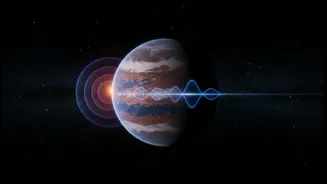
K2-18b is no Earth twin. It's a 'sub-Neptune,' about 8.6 times the mass of our planet, and orbits a cool red dwarf star. What makes it so compelling is that it's a leading candidate for being a 'Hycean' world—a theorised type of planet with a deep, global
ocean of liquid water beneath a hydrogen-rich atmosphere. This combination is intriguing because, while unlike Earth, the conditions in such an ocean could potentially be similar to those that support microbial life here. The James Webb Space Telescope (JWST) has already detected key carbon-bearing molecules like methane and carbon dioxide in its atmosphere, which supports the Hycean model.
Searching for Chemical Clues
The hunt for life on K2-18b has largely been driven by the JWST, which analyses starlight passing through the planet's atmosphere to detect its chemical makeup. The most electrifying, though highly debated, finding has been the potential hint of dimethyl sulfide (DMS). On Earth, DMS is overwhelmingly produced by life, particularly marine phytoplankton. Finding it on another world would be a monumental discovery. However, the scientific community is deeply divided. The signal is weak, and several independent teams re-analysing the same data have concluded there is insufficient evidence for DMS, suggesting instrumental noise or other molecules could be responsible. It's a classic case of science in action: an extraordinary claim that requires extraordinary evidence, which is not yet in hand.
Listening for Technosignatures
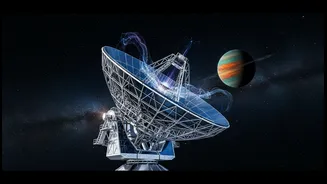
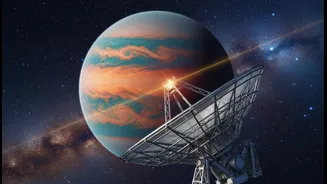
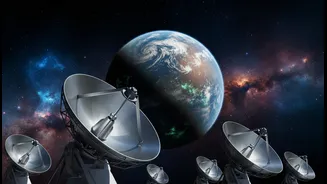
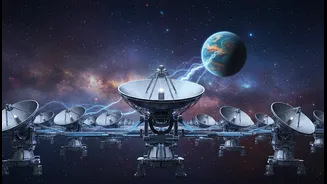
The headline-making radio survey represents a different, complementary approach. While JWST searches for 'biosignatures'—chemical traces of biological processes—a recent project used powerful radio telescopes to listen for 'technosignatures'. This involves searching for narrow-band radio signals that would indicate the presence of technology comparable to our own. A team of researchers recently used the Karl G. Jansky Very Large Array (VLA) in New Mexico and the MeerKAT radio telescope in South Africa to conduct a deep scan of the K2-18b system. This massive search sifted through millions of potential signals, using advanced software to filter out interference from Earth.
The Sound of Silence... For Now
The comprehensive radio survey did not detect any convincing artificial transmissions from K2-18b. While this might seem like a disappointing result, it provides valuable information. Firstly, it allows astronomers to set an upper limit on the strength of any potential transmitters on the planet. Secondly, the lack of radio emissions from the host star itself is actually great news. It suggests K2-18 is an unusually 'quiet' star, meaning its planet is less likely to have its atmosphere stripped away by intense stellar radiation and flares. This calmness helps preserve the very atmosphere that JWST is studying, making it a more stable environment for potential life. Even without finding a signal, the survey has successfully demonstrated a powerful new technique for future SETI (Search for Extraterrestrial Intelligence) searches.
What Comes Next in the Search?
The mystery of K2-18b is far from solved. The scientific debate over the presence of dimethyl sulfide continues, with researchers calling for more observation time with the JWST to either confirm or refute the tentative signal. Getting a definitive answer requires crossing a higher threshold of statistical certainty. Even if the DMS signal is eventually confirmed, the next step would be to rule out any non-biological chemical processes that could produce it. For now, K2-18b remains a tantalising world at the frontier of astrobiology. It serves as a crucial test case, pushing our technology and scientific methods to their limits as we learn how to properly identify the first credible signs of life beyond our solar system.