



Reading the Starlight
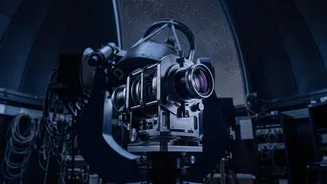
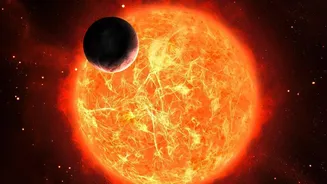
The entire process begins with a tiny dip in a star’s light. When an exoplanet passes in front of its host star, an event called a transit, it blocks a minuscule amount of starlight. Telescopes like the James Webb Space Telescope (JWST) are sensitive
enough to not only detect this dip but also to analyze the light that passes through the planet’s atmosphere. This technique, called transmission spectroscopy, is the cornerstone of understanding exoplanet climates. Just as a prism splits white light into a rainbow, spectroscopy splits the starlight into its component colours, or wavelengths. Different molecules in the planet's atmosphere absorb specific wavelengths, leaving a unique chemical 'fingerprint' in the light that reaches us. By reading these fingerprints, scientists can identify gases like water vapour, carbon dioxide, and methane.
Building a Digital Planet
Gathering atmospheric data is just the first step. To understand the climate, scientists feed this information into complex computer simulations called Global Climate Models (GCMs). These are sophisticated programs, often adapted from models used to study Earth's own climate, that apply the fundamental laws of physics and chemistry. The model takes key planetary properties as inputs: the type and energy output of the host star, the planet’s size and mass, its distance from the star, and the atmospheric gases detected through spectroscopy. The simulation then calculates how these factors interact, predicting everything from surface temperature and wind patterns to cloud formation and potential weather. It’s like creating a 'digital twin' of the exoplanet to see if the conditions could permit liquid water.
The Search for Liquid Water
The primary goal for many of these climate models is to determine if a planet can support liquid water on its surface. Life as we know it depends on water, so its potential presence is a key indicator of habitability. Scientists use the models to predict the surface temperature based on the balance of energy received from the star and the heat trapped by the atmosphere's greenhouse gases. This leads to the concept of the 'habitable zone', often nicknamed the 'Goldilocks zone', which is the orbital region around a star where temperatures are just right—not too hot and not too cold—for liquid water to exist. A planet within this zone is a prime candidate for further study.
What is a Habitability Index?
A habitability index is not a single, universally agreed-upon score, but rather a tool to rank and prioritize exoplanets for further observation. Various indices exist, such as the Earth Similarity Index (ESI), which compares a planet's radius, density, and surface temperature to Earth's. Another, the Habitability Index for Transiting Exoplanets (HITE), calculates the probability of a planet having liquid surface water by considering its rockiness and orbital path. These indices combine multiple factors into a comparative rating. It’s important to remember that a high score doesn't guarantee life; it simply means the planet shares characteristics with worlds we consider potentially habitable.
Looking for 'Biosignatures'
Beyond just water, scientists are hunting for 'biosignatures'—gases or chemical combinations that strongly suggest the presence of life. On Earth, almost every gas in our atmosphere is influenced by biological activity. One promising area of research is looking for chemical imbalances, like the simultaneous presence of methane and carbon dioxide, which on Earth points toward biological processes. The recent detection of dimethyl sulfide on exoplanet K2-18b, a gas only produced by life on Earth, is a tantalizing, though not yet conclusive, potential biosignature. However, scientists are cautious, as these signs could also be produced by unknown geological or chemical processes.
Habitable vs. Inhabited
It is crucial to distinguish between a planet being 'habitable' and 'inhabited'. The models and indices provide a measure of potential. They tell us if the conditions could be right for life. Confirming that a planet is actually inhabited is a much higher bar. The data from even the most powerful telescopes can lead to multiple interpretations. For example, the atmospheric signals from a water world could be interpreted in different ways, and ruling out non-biological explanations for potential biosignatures is a monumental challenge that will require multiple lines of evidence and extensive follow-up studies. The search for life is a process, and every new piece of data helps refine our understanding and focus our efforts.