



Our Old Cosmic Story
Until recently, the prevailing theory painted a picture of slow, self-regulated star birth. The idea was that vast clouds of cold gas and dust, called molecular clouds, would slowly collapse under their own gravity to form dense cores. These cores would eventually
ignite into stars. Once the most massive and brilliant of these new stars flared to life, they would unleash powerful radiation and stellar winds—a process known as 'stellar feedback'. This feedback was thought to be so powerful that it would quickly blow away the remaining gas cloud, effectively shutting down further star formation in the region. This entire process was believed to unfold over several million years, with feedback acting as a cosmic thermostat, keeping the pace of star birth relatively slow and inefficient.
What Webb Actually Saw
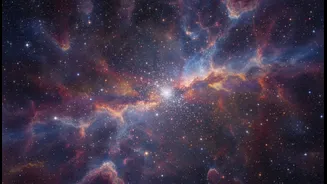
The James Webb Space Telescope (JWST), with its unparalleled ability to peer through cosmic dust in infrared light, has given us an unprecedented look inside these stellar nurseries. What it revealed has been shocking. Instead of seeing evidence of feedback mechanisms efficiently clearing out the gas, Webb’s images show that the initial impact of young, massive stars is far less destructive than models predicted. Observations of regions like the Lobster Nebula and star cluster NGC 346 show that as young stars begin to shine, the surrounding gas isn't immediately blasted into oblivion. Instead, intricate structures of gas and dust remain surprisingly intact, suggesting that the initial feedback isn't the all-powerful dispersing agent we once believed it to be. This was the first major crack in the old theory.
A Faster, More Furious Process
This new evidence has led to a radical recalibration of the timeline. The old model suggested a long, drawn-out process where the star-forming phase of a cloud could last for millions of years before feedback eventually won out. The new picture is one of a much faster, more dynamic, and explosive event. While the initial feedback from young stars is less destructive, it appears that once the process kicks into high gear, the cloud is dispersed much more rapidly than previously thought. Star formation isn't a slow simmer; it's a rapid burst. Some recent research suggests the entire lifespan of a star-forming region, from a dense cloud to a collection of young stars with the gas cleared away, might be significantly shorter than our models accounted for. This shift from a slow, regulated process to a rapid, explosive one has profound implications.
Rethinking Planet Formation
The lifespan of these star-forming regions is critical because it sets the clock for everything that happens within them, including the formation of planets. Planets form from the leftover material in a protoplanetary disk swirling around a young star. The old models, with their long timelines, gave planets plenty of time to form. The new, shorter timelines create a cosmic puzzle. If the parent gas cloud is dispersed much more quickly, how do planets—especially large gas giants—have enough time to grow? However, other Webb discoveries have shown that in the early universe, which was less rich in heavy elements, protoplanetary disks may have actually lasted longer than expected. This seemingly contradictory evidence—faster cloud dispersal but potentially longer-lasting disks in some environments—is precisely what scientists are now trying to reconcile. It suggests the processes are more complex and environment-dependent than we ever imagined.
Why This Recalibration Matters
This isn't just an academic debate. The speed and efficiency of star formation are fundamental inputs for virtually all models of galaxy formation and evolution. If our assumptions about how quickly stars form and how long their nurseries last are wrong, then our understanding of how galaxies like our own Milky Way were built is also incomplete. Webb's findings are forcing a top-to-bottom re-evaluation of the physics of stellar feedback and its role in the cosmos. These new observations are the 'ground truth' that theoretical models must now match. It’s a challenging moment for astrophysicists, but also an incredibly exciting one. They are not just tweaking old theories; they are building new ones on a foundation of real, revolutionary data.