
The Stellar Graveyard
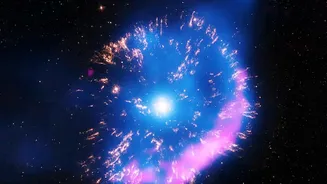
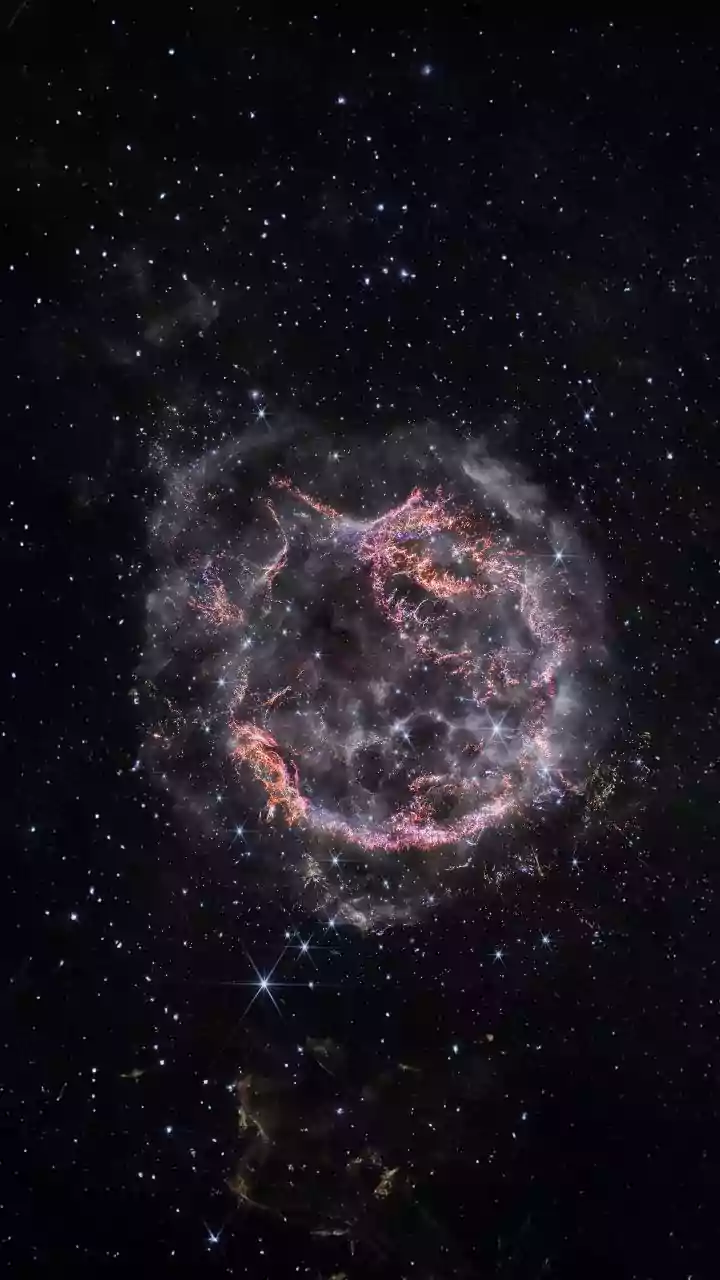
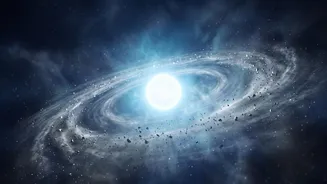
Most stars in the universe, including our own Sun, are destined to become white dwarfs. After a star exhausts its nuclear fuel, it swells into a red giant, often engulfing any nearby planets, before shedding its outer layers and collapsing into a super-dense,
Earth-sized core. This stellar remnant is a white dwarf—a glowing ember in the cosmic graveyard. For a long time, this was considered the final act. Any planets that survived the red giant phase would orbit this dead star, but the system's creative days were thought to be over. The intense gravity of a white dwarf should, in theory, create an incredibly pure atmosphere; heavy elements sink, leaving only a thin veneer of the lightest elements, hydrogen and helium, on the surface. This is why finding anything else is so surprising.
A Contaminated Crime Scene
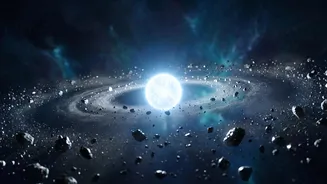
For years, astronomers have been finding white dwarfs whose atmospheres are 'polluted' with heavy elements like iron, silicon, and magnesium. The leading theory was that these were the remnants of first-generation planets or asteroids from the original solar system. The idea is that the orbits of these leftover rocky bodies can become unstable, causing them to fall into the white dwarf, where they are torn apart and consumed. The composition of this debris acts like a cosmic autopsy, giving astronomers a unique chance to study the chemical makeup of distant exoplanets. However, recent findings around a white dwarf named HS 0209+0832 presented a chemical signature that didn't fit this neat picture.
The Niobium Anomaly
By re-examining 25-year-old data from the Hubble Space Telescope, a team led by astronomers from the University of Warwick made a stunning discovery. The atmosphere of HS 0209+0832 wasn't just polluted with standard rock-forming elements; it contained unusually heavy elements, including copper, zinc, and most importantly, niobium. The level of niobium was over 1,000 times higher than that of our Sun. This was a critical clue. Niobium is an element that can only be forged in the extreme conditions inside a massive, dying star during a process that builds heavy elements. A normal, first-generation planet shouldn't have such a high concentration of it. The mysterious elements were a sign that something else was going on—something that pointed not to destruction, but to creation.
A Cosmic Phoenix: The Second-Generation Hypothesis
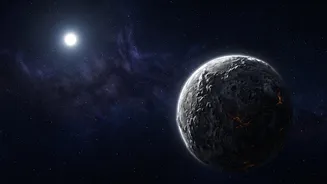
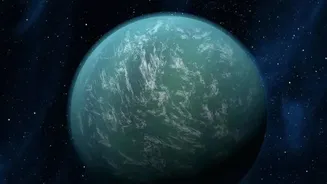
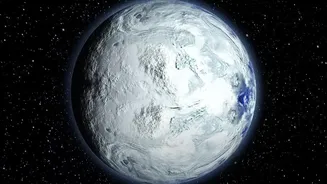
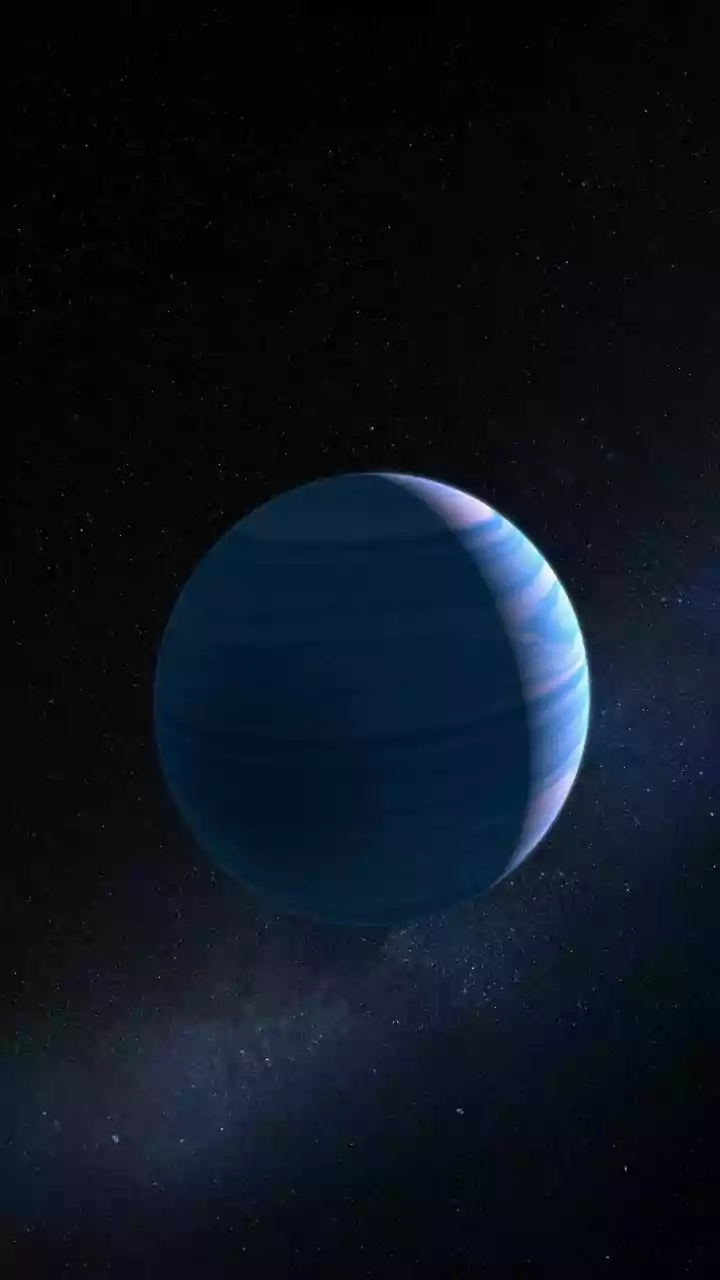
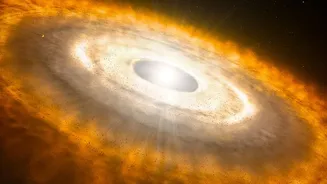
This leads to the exciting new hypothesis: a 'second-generation' planet. Scientists propose that after the original star died, the material it cast off—rich in newly forged heavy elements like niobium—didn't just dissipate. Instead, some of this material formed a new disk around the white dwarf, a protoplanetary disk from which a brand-new planet could condense and form. This proposed planet, likely a Jupiter-sized gas giant, is now thought to be orbiting the white dwarf in a tight, 4.4-day orbit. The white dwarf's intense radiation is likely boiling away the planet's atmosphere, causing a stream of this uniquely enriched material to rain down onto the star, creating the strange chemical signature that scientists detected.
A New Chapter in Planetary Science
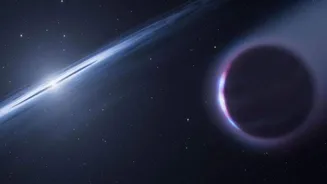
If confirmed, HS 0209+0832 would be the first white dwarf found to host a second-generation planet. While such 'phoenix planets' have been theorised to exist around other stellar remnants like pulsars, finding one around a far more common white dwarf is a game-changer. It suggests that the end of a star's life might not be the end for planetary systems. Instead, it could be the beginning of a new cycle of formation, a cosmic rebirth where new worlds can rise from the ashes of the old. This discovery opens up a new avenue for finding these incredibly rare planets by looking for the tell-tale chemical signature of elements like niobium in other dead stars.