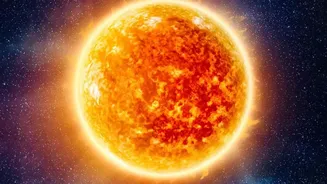



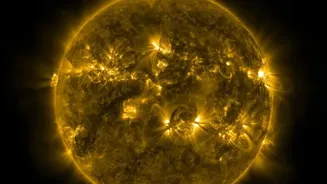
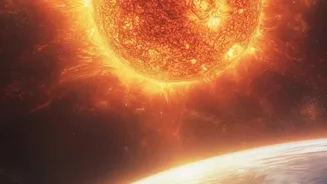
A Threat from the Sun
Our modern world runs on electricity and data. From power grids and GPS navigation to the satellites that enable global communications and financial transactions, we rely on a delicate technological web. This entire system is vulnerable to a powerful
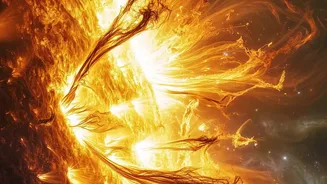
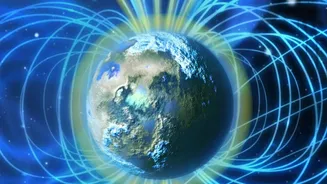
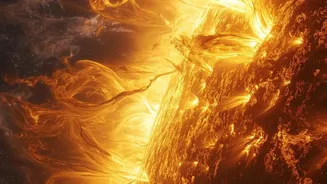
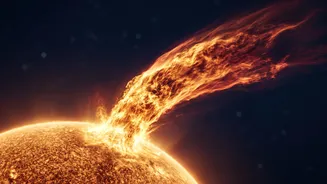
force of nature: solar storms. These events, which include solar flares and coronal mass ejections (CMEs), send massive bursts of radiation and charged particles hurtling through space. If Earth is in the path of one of these eruptions, the resulting geomagnetic storm can have devastating consequences. The most severe storms could overload power grids, causing widespread and long-lasting blackouts, permanently damage satellites, and disrupt radio communications. The infamous Carrington Event of 1859, which set telegraph offices on fire, serves as a stark reminder of the sun's destructive potential in a far less technologically dependent era.
The Forecasting Challenge
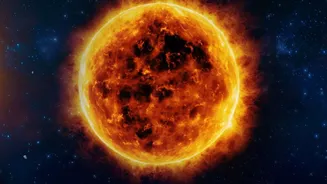
For decades, predicting space weather has been an incredibly difficult task. Scientists monitor the sun constantly, looking for signs of an impending eruption. However, the sun is 150 million kilometres away, and distinguishing a harmless solar burp from a truly threatening, Earth-directed storm is a major challenge. Traditional forecasting methods rely on interpreting vast and complex datasets from solar observatories. This process can be slow and is often more of an art than an exact science. The sheer volume of data, combined with our incomplete understanding of the sun's magnetic processes, means that warnings are often issued with little lead time, and false alarms can be frequent. This uncertainty makes it difficult for power grid operators and satellite companies to decide when to take costly protective measures.
AI as a Solar Watchdog
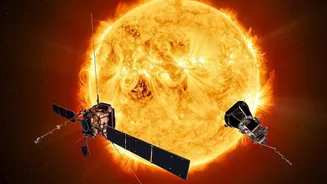
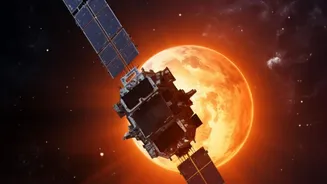
This is where artificial intelligence comes in. By applying machine learning techniques to decades of solar data, scientists are building powerful new forecasting tools. AI models are trained on countless images and measurements from missions like NASA’s Solar Dynamics Observatory. Through a process called deep learning, these models learn to identify the subtle, complex patterns in the sun's magnetic field and plasma that often precede an eruption. These precursor signals are frequently too faint or complex for a human analyst to spot reliably. In essence, scientists are teaching AI to be an expert solar watchdog, capable of sifting through immense datasets to find the tell-tale signs of an impending storm.
Faster Warnings and Fewer False Alarms
The most immediate benefit of using AI is a dramatic improvement in warning times. One pioneering model known as DAGGER (Deep Learning Geomagnetic Perturbation) can now predict the specific, on-the-ground impact of a solar storm with about 30 minutes of notice. This might not sound like much, but for an electricity grid operator, that half-hour is a critical window to stabilize the network and prevent catastrophic failure. More recent research in August 2026 revealed a model called EarlyDetect, which can spot the formation of potentially volatile active regions on the sun nearly nine hours before they become clearly visible. AI isn't just faster; it's also smarter. These tools are getting better at predicting which storms will actually hit Earth, reducing the number of false alarms that can lead to 'cry wolf' syndrome among infrastructure operators.
Unlocking the Sun's Secrets
Beyond just forecasting, AI is providing scientists with fundamental new insights into the sun's behaviour. By analyzing what patterns the AI models are focusing on, researchers can better understand the physics behind solar eruptions. This serves as a powerful research tool, helping to solve long-standing mysteries about what triggers the most powerful flares and CMEs. For example, AI can help map the sun's complex magnetic fields in three dimensions, revealing the configurations that are most likely to become unstable and erupt. This dual role as both a practical forecasting engine and a scientific discovery tool is accelerating our understanding of our nearest star, paving the way for even more advanced prediction capabilities in the future.