



A World of Possibility
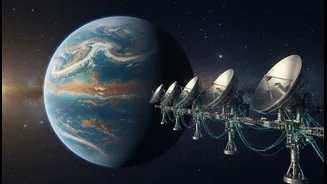
Located 124 light-years away, K2-18b is one of the most intriguing exoplanets discovered to date. It’s a 'sub-Neptune,' larger than Earth but smaller than Neptune, orbiting its star within the habitable zone—the region where liquid water could exist.
Observations from the James Webb Space Telescope (JWST) have made it even more tantalizing, revealing an atmosphere containing methane and carbon dioxide. These findings led to the hypothesis that K2-18b could be a 'Hycean' world: a planet with a global ocean under a hydrogen-rich atmosphere, a promising environment for life as we know it. The initial excitement was further amplified by a possible, though highly debated, detection of dimethyl sulfide (DMS), a gas that on Earth is predominantly produced by marine life. This made K2-18b a prime target, not just for signs of life (biosignatures), but for signs of intelligent life (technosignatures).
Life vs. Technology
In the search for extraterrestrial existence, scientists look for two types of clues: biosignatures and technosignatures. A biosignature is any substance or phenomenon that provides evidence of life, like the potential DMS on K2-18b. A technosignature, a term coined by astronomer Jill Tarter, is evidence of technology. This could be anything from industrial pollutants in an atmosphere, the heat glow of massive structures like a Dyson sphere, or, most famously, artificial radio signals. While the search for biosignatures looks for life in any form, the search for technosignatures specifically hunts for intelligent, tool-building civilizations. The two searches are complementary; finding one could lead to the other, and both are part of NASA's mission to answer the ultimate question of whether we are alone.
Listening for a Signal
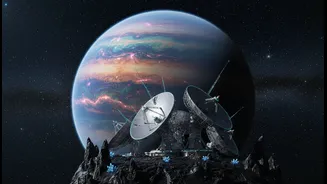
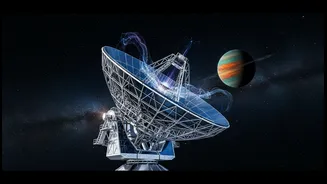
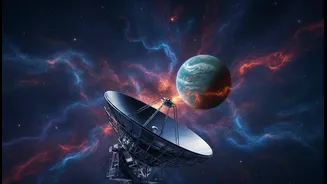
Given its potential, K2-18b became the subject of one of the most sensitive technosignature searches ever conducted. Researchers used two of the world's most powerful radio telescope arrays—the Karl G. Jansky Very Large Array (VLA) in the US and the MeerKAT in South Africa—to listen intently for any artificial, narrowband radio signals coming from the planet's system. Coordinating such massive facilities is rare and provided an exceptionally powerful scan. The team observed the system for an entire planetary year of K2-18b, about 33 Earth days, covering a wide range of frequencies. The challenge was immense: sifting through millions of potential signals to find one that was unambiguously artificial and not just interference from our own planet's noisy technology.
The Sound of Silence
After a painstaking analysis involving multiple advanced filtering techniques, the result was clear: silence. Of the millions of candidate signals detected, none survived the rigorous screening process designed to weed out Earth-based interference and natural cosmic noise. The researchers found no convincing technosignatures. This might sound like a disappointing outcome, but in science, a null result is not a failure; it is data. The search allowed astronomers to place an 'upper bound' on any potential transmissions from K2-18b. This means that if a civilization exists there, it isn't broadcasting with any technology more powerful than what we have on Earth, such as the famous, now-collapsed Arecibo radio telescope. They are not shouting into the cosmos, at least not in a way we can currently hear.
A Smarter Search Ahead
The true victory of the K2-18b technosignature search lies in the method itself. The project demonstrated a powerful new approach for future SETI searches, developing an automated filtering system capable of managing the massive amounts of data from modern telescopes. This framework is now a proven tool that can be applied to other promising worlds, making future searches faster, more effective, and far more efficient. It has refined our techniques, managed our expectations, and sharpened our tools. The quest to understand K2-18b, both its potential for life and its apparent lack of technology, has been a crucial dress rehearsal. It shows how the scientific process works—with hype, careful investigation, cautious results, and steady progress.