


The Old Picture: A Violent Cosmic Youth
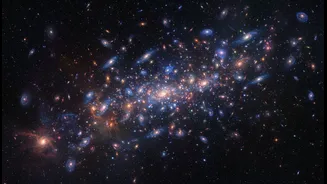
The long-held consensus among cosmologists was that the first billion or two years after the Big Bang were a period of intense and violent change. According to this model, galaxies were clumpy, irregular, and constantly colliding. These frequent mergers
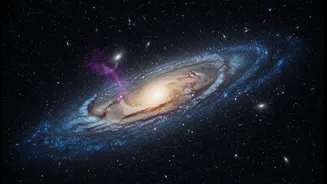
and bursts of star formation would have stirred up enormous amounts of gas, making it difficult for stable, orderly structures to form. Scientists believed that features common in modern galaxies, like the majestic spiral arms of our own Milky Way, required billions of years of cosmic settling to develop. Early galaxies were seen as the chaotic building blocks of the grand structures we see today, not as developed systems in their own right. This theory made logical sense—it takes time to build something as complex as a galaxy, and the early universe was a turbulent construction site.
A Surprising Discovery of Maturity
Recent observations, primarily from the James Webb Space Telescope (JWST), have provided a shocking contradiction to this picture. Astronomers have discovered galaxies with surprisingly mature features at a time when the universe was just a fraction of its current age. The most startling of these findings is the presence of 'stellar bars'—elongated, dense structures of stars that cut across the center of a galaxy. Our own Milky Way has a bar, but it was thought to be a feature of highly evolved, stable galaxies. Finding them in galaxies that existed 11 billion years ago or more is like finding a fully-grown adult in a cosmic nursery. These bars are not supposed to exist in the gas-rich, turbulent environments of the early universe, and their presence challenges at least three separate theoretical predictions about galaxy formation.
The Power of a New Cosmic Eye
This wave of discovery has been powered by the unparalleled capabilities of the James Webb Space Telescope. Because light takes time to travel across the vastness of space, looking at extremely distant galaxies is equivalent to looking back in time. The light from these ancient galaxies, emitted over 13 billion years ago, has been stretched by the expansion of the universe into infrared wavelengths. The JWST is specifically designed to see this infrared light, allowing it to peer through cosmic dust and capture images of galaxies that existed less than a billion years after the Big Bang. Where the Hubble Space Telescope saw faint, blurry smudges, Webb sees clear, defined structures. In one instance, a stellar bar that was barely visible in Hubble data 'popped out' in the Webb image, showcasing the new telescope's immense power to see underlying galactic structures.
Rewriting the Galactic Playbook
The discovery of these stable, barred galaxies so early in cosmic history means that the models for how galaxies form and evolve need a major revision. The existence of these structures suggests that the process of galaxy maturation can happen much faster than previously believed. Bars are significant because they are known to channel gas toward a galaxy's center, accelerating the production of new stars and helping to build up the central bulge. The fact that this mechanism was already at work so early on implies that galaxies could organize themselves far more efficiently than our theories allowed. This is not just a one-off anomaly; Webb has consistently found a pattern of early maturity, from massive galaxies to the host galaxies of ancient quasars, forcing astronomers to rethink the entire timeline of cosmic evolution.