




The Sun's Unpredictable Fury
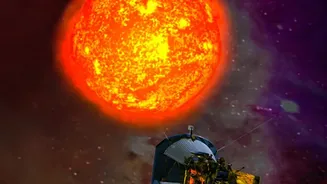
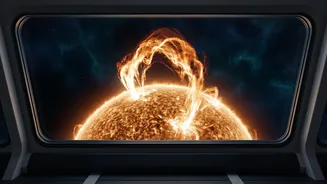
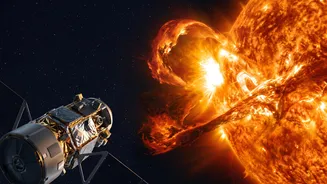
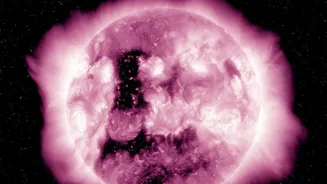
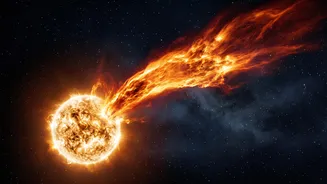
Imagine the Sun blasting out a colossal cloud of magnetised plasma, a billion-tonne cannonball of energy hurtling through space. This is a coronal mass ejection (CME), and when one heads for Earth, we call it a solar storm. While our planet's magnetic
field protects us from most of the Sun's constant outflow, a direct hit from a powerful CME is a different story. These events can trigger geomagnetic storms, which are major disturbances in our magnetic field. The most famous example is the 1859 Carrington Event, a solar superstorm so powerful it made auroras visible near the equator and caused telegraph systems to burst into flames. If a storm of that magnitude occurred today, the consequences would be catastrophic for our technology-dependent society.
A World Held Together by Wires and Satellites
Our modern world runs on electricity and data. A Carrington-level event could induce powerful electrical currents in our power grids, blowing out critical transformers and leading to widespread, long-lasting blackouts that could affect millions for weeks or even months. But the damage wouldn't stop there. Satellites, which are essential for everything from GPS navigation and financial transactions to internet service and weather forecasting, are highly vulnerable. A major storm could fry their electronics, degrade their solar panels, or even cause them to fall out of orbit, effectively crippling global communication and logistics networks. The economic fallout is estimated to be in the trillions of dollars, disrupting supply chains and the very foundation of modern life.
The Urgent Need for a Better Warning System
The fundamental problem with defending against solar storms is time. Currently, once a CME erupts from the Sun, it can take anywhere from one to several days to reach Earth. While we can see it happen, predicting its exact trajectory and, more importantly, its specific geomagnetic impact upon arrival has been a slow and imprecise science. Existing models could take hours to run or provide only localized forecasts. For power grid operators and satellite controllers, this isn't enough lead time to take meaningful protective measures, like strategically shutting down parts of the grid or putting satellites into a protective safe mode. We needed a faster, more accurate forecast—something that could act like a tornado siren for space weather.
Enter DAGGER: NASA's AI Forecaster
This is the problem NASA's new AI research aims to solve. In collaboration with international researchers, NASA has developed a groundbreaking model called DAGGER, which stands for Deep Learning Geomagnetic Perturbation. Instead of relying on slow physics-based models, DAGGER uses artificial intelligence to rapidly analyze real-time data from a fleet of sun-observing spacecraft. By training on vast amounts of historical data, the AI has learned to identify the subtle connections between solar wind conditions and the resulting geomagnetic disturbances on Earth. This allows it to issue a specific, worldwide forecast with unprecedented speed.
From Hours to Minutes: A Game-Changing Advantage
The key breakthrough of the DAGGER model is its speed. It can predict where a solar storm will strike and how intense its effects will be anywhere on Earth with just 30 minutes of advance warning. While 30 minutes may not sound like much, in the world of infrastructure protection, it is a game-changer. This window is enough time for utility companies to reconfigure power grids to minimize damage, for satellite operators to adjust their spacecraft, and for airlines to reroute flights away from polar regions where radiation exposure is higher. According to Vishal Upendran, a lead author on the research, this AI makes it possible to "minimize – or even prevent – devastation to modern society."