



A World of Fading Colour
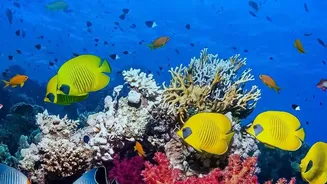
Coral reefs are the vibrant, bustling cities of the ocean, supporting a quarter of all marine life. But these ecosystems are in crisis. When ocean temperatures rise, corals expel the tiny algae living in their tissues, causing them to turn white in a process
known as bleaching. If the heat stress is prolonged, the corals starve and die. This phenomenon is accelerating globally, threatening not only marine biodiversity but also the millions of people who depend on reefs for food, income, and coastal protection. The scale of the problem is immense, but in this challenge lies a glimmer of hope: some corals are naturally tougher than others.
The Hunt for 'Super Corals'
Not all corals bleach at the same rate. Scientists have observed that even within a single reef during a marine heatwave, some corals remain colourful and healthy while their neighbours bleach. These resilient individuals, often called 'super corals', are the focus of intense research. The key is to determine whether their resilience is due to a lucky location or a genuine, heritable trait. If their heat tolerance is written in their genes, it means this survival advantage can be passed down to future generations, offering a vital tool for conservation. Identifying these super corals is the critical first step in a larger strategy to help reefs adapt to a warmer future.
Turning Up the Heat in the Lab
One of the most direct ways to find heat-tolerant corals is to test them. Researchers collect small fragments from various corals and bring them into the lab or use mobile testing units. A key method is the 'rapid heat stress test', where corals are placed in tanks and the water temperature is gradually increased to simulate a future heatwave. Scientists meticulously observe which fragments bleach and at what temperature. This controlled 'stress test' allows them to rank individual corals based on their performance, providing clear, empirical evidence of their thermal tolerance much faster than waiting for a natural bleaching event.
Decoding the Genetic Blueprint
While stress tests identify which corals are tough, genetic analysis helps explain why. After a coral proves its resilience, scientists sequence its DNA and that of the symbiotic algae within it. This allows them to search for specific genetic markers—unique sequences in the DNA—that are associated with heat tolerance. Advanced techniques like CRISPR gene editing are even being used to understand the function of specific genes involved in the stress response. By identifying these genomic signatures, scientists can potentially screen wild coral populations more quickly, looking for the genetic potential for resilience without having to physically stress-test every single one.
Relevance for India's Coastal Jewels
These global research efforts hold immense importance for India, which is home to significant reef ecosystems in the Andaman and Nicobar Islands, Lakshadweep, the Gulf of Mannar, and the Gulf of Kutch. These reefs are biodiversity hotspots and crucial for coastal communities. Several restoration projects are already underway in India, focusing on transplanting coral fragments to degraded areas. Incorporating the science of heat tolerance could make these efforts even more effective. For example, the Zoological Survey of India (ZSI) has initiated projects to cultivate and transplant heat-resistant species in the Andaman & Nicobar Islands. Another innovative technique being explored in the Gulf of Kutch is 'Biorock' technology, which uses a low-voltage electrical current to accelerate coral growth on steel structures.
From Discovery to Restoration
Identifying super corals is not just an academic exercise. The ultimate goal is to use this knowledge for proactive restoration. This involves several strategies. One is selective breeding, where the most heat-tolerant corals are bred to produce even more resilient offspring. Another is to grow fragments of these proven survivors in underwater nurseries before transplanting them onto degraded reefs, a process known as 'coral gardening'. By focusing restoration efforts on these climate-resilient corals, conservationists hope to build reefs that have a better chance of surviving future heatwaves, essentially helping to future-proof these vital ecosystems.