

The Moon’s Hidden Sanctuaries
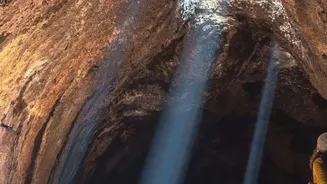
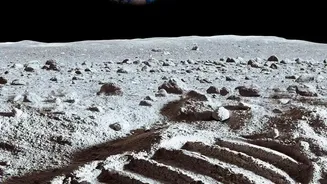
For decades, scientists have theorized that vast, hollow tunnels lie just beneath the lunar surface. These are not ordinary caves, but lava tubes, formed billions of years ago when the Moon was still volcanically active. Rivers of lava flowing across
the surface would have cooled and hardened on top, creating a solid crust while molten rock continued to flow underneath. Once the eruption ended and the lava drained away, it left behind enormous, empty conduits. Some of these tubes are thought to be vast, potentially hundreds of meters wide and stretching for kilometers, large enough to house entire cities. Orbiters have spotted hundreds of 'skylights'—collapsed sections of roofing that appear as deep pits on the surface—which are believed to be gateways into these subterranean networks. This has transformed them from a geological curiosity into prime real estate for future lunar inhabitants.
A Hostile Surface Environment
The lunar surface is one of the most inhospitable places imaginable. With no atmosphere or global magnetic field, it is constantly bombarded with deadly cosmic radiation and particles from solar flares. On the surface, an astronaut would be exposed to radiation levels far exceeding safe limits for humans on Earth. These lava tubes, however, offer a natural solution. Their thick ceilings of solid rock provide a powerful shield, reducing radiation exposure to levels comparable to what we experience on Earth. Beyond radiation, the tubes also offer protection from the Moon's extreme temperature swings, which can range from a scorching 120°C in sunlight to a frigid -230°C in darkness. Inside a lava tube, the temperature remains relatively stable. Finally, they offer shelter from the constant threat of micrometeorite impacts that pepper the surface.
Enter the Robotic Cave Explorers
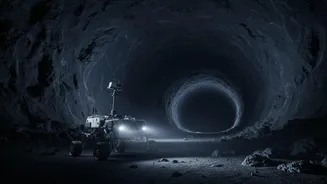
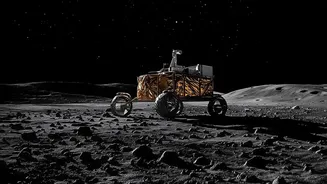
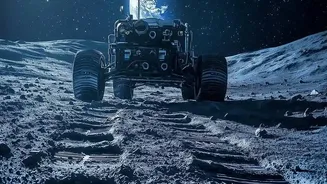
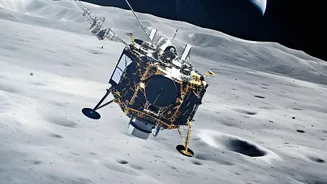
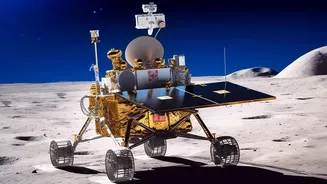
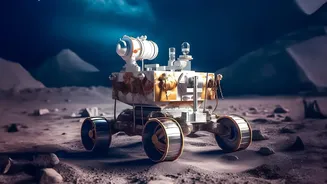
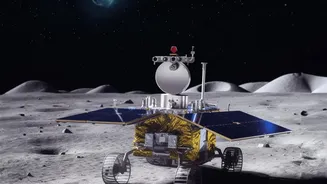
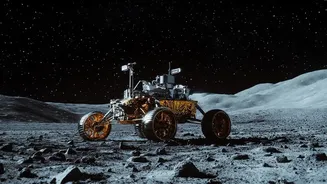
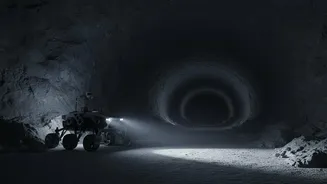
Before humans can set up camp, we need to know what’s inside these tubes. Are they structurally sound? What is the terrain like? This is where a new class of specialized subterranean rovers comes in. Exploring these pits and caves is too dangerous and complex for current rover designs. In response, space agencies like the European Space Agency (ESA) and NASA are funding concepts for robots designed specifically for this task. The ESA, for instance, has studied concepts like DAEDALUS, a spherical, 46-cm diameter probe that could be lowered into a pit on a tether before rolling away to map the cave autonomously. Another collaborative European concept envisions a trio of robots working together: one to map the entrance, another to lower a scout rover, and the scout itself to explore the interior.
New Technology for a New Frontier
These are not your average rovers. They must operate in complete darkness, navigate treacherous, unknown terrain, and function with a high degree of autonomy, as direct communication with Earth will be impossible. Many proposed designs are equipped with advanced sensor suites, including LiDAR for 3D mapping, stereoscopic cameras for vision, and instruments to analyze the rock for resources like water ice. Recently, NASA funded a particularly novel idea from Stone Aerospace: the Lunar Underground eXplorer (LUX). This concept involves a hovering drone-like vehicle tethered to a surface rover by a fiber-optic cable. This single cable would provide power via laser, transmit high-speed data, and even support the vehicle's propulsion system, allowing it to explore deep within the caves where wheels cannot go.
The Blueprint for a Lunar Base
The data collected by these robotic pioneers will be crucial for planning the first permanent human outpost on another world. By confirming the stability, size, and environmental conditions inside these lava tubes, space agencies can design habitats that leverage the natural protection they offer. Instead of spending billions to transport heavy shielding materials from Earth, future lunar architects could build inflatable or modular habitats inside these pre-existing, radiation-safe caverns. This dramatically lowers the cost and complexity of establishing a long-term human presence. These stable, protected environments could serve not just as living quarters but also as laboratories, storage depots, and resource processing facilities, laying the groundwork for a sustainable off-world economy and a new chapter in human exploration.