
The Sun's Hottest Mystery
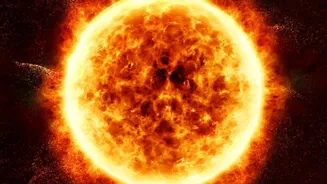
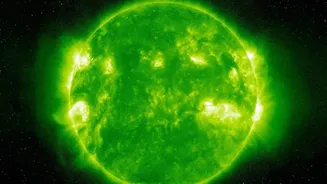
For nearly a century, solar physicists have been puzzled by a seemingly impossible fact. The Sun's visible surface, known as the photosphere, sizzles at about 6,000 degrees Celsius. Logic dictates that as you move away from a heat source, the temperature
should drop. Yet the Sun’s outer atmosphere, the corona, burns at a mind-boggling 2 million degrees. This phenomenon, known as the coronal heating problem, defies the basic laws of thermodynamics and has remained one of the biggest unsolved questions in astrophysics since it was first identified in the 1930s. How can the air be hotter than the fire? Scientists have long theorised that the answer must lie not in simple heat transfer, but in some other mechanism that pumps enormous amounts of energy from the Sun's interior out into its wispy, superheated corona.
A Whirlwind Discovery
Now, a breakthrough observation offers the most compelling evidence yet for what's happening. Using the Daniel K. Inouye Solar Telescope in Hawaii, the world’s largest and most powerful solar observatory, scientists have captured the sharpest images ever of the Sun's surface. These unprecedented images reveal tiny, swirling vortices of plasma—superheated gas—at the edges of solar structures called granules. Published in the journal Nature, the discovery marks the first confirmed observation of a phenomenon called Kelvin-Helmholtz instability on the Sun's surface. These are not just any plasma waves; they are tiny, powerful whirlpools, some just a few dozen kilometres across, that are believed to play a crucial role in transferring energy.
How the Waves Heat the Corona
The Kelvin-Helmholtz instability occurs when two layers of fluid—or in this case, plasma—slide past each other at different speeds. This creates a shear force that causes wave-like curls to form at the boundary, which can grow into spiralling vortices. Think of the way wind creates waves on the surface of water. On the Sun, these tiny whirlpools are generated at the edges of granules, which are massive convection cells of rising hot plasma. The vortices take the kinetic energy of this churning plasma and twist the Sun's magnetic field lines, which are rooted in the photosphere but extend far out into the corona. This twisting acts like coiling a spring, storing immense magnetic energy that is then transported upwards along the field lines and released as heat, contributing to the corona's extreme temperatures. The process essentially acts as a hidden engine, converting motion on the surface into heat in the atmosphere.
Putting the Pieces Together
This discovery builds on years of research from other missions, like the Solar Orbiter, which have also detected various types of magnetic waves, known as Alfvén waves, that contribute to heating. Scientists suspected these waves were responsible, but earlier observations couldn't detect waves with enough energy to account for the massive temperature difference. The new, high-resolution observations from the Inouye telescope finally reveal the small-scale, high-energy processes that were previously invisible. These tiny vortices seem to be the missing link, providing a mechanism for injecting the necessary energy into the corona. While this may not be the sole cause of coronal heating, researchers believe it is a significant part of the solution to this long-standing puzzle.
Why This Matters for Earth
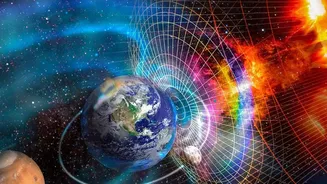
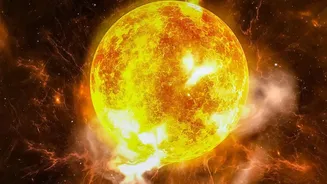
Understanding the Sun’s behaviour isn't just an academic exercise. The same mechanisms that heat the corona also drive space weather, including solar flares and coronal mass ejections. These massive eruptions of energy and charged particles can have serious consequences for us on Earth, disrupting satellite communications, damaging power grids, and posing a risk to GPS systems. By finally observing the intricate twisting motions that energise the corona, scientists can build better models to predict when and how these explosive events might occur. These new insights into our host star provide a foundational piece for better protecting our increasingly technology-dependent world from the Sun's powerful outbursts.