



The Challenge of Seeing the Past
To understand the universe's origin, we must look at its infancy. Because light takes time to travel, looking at distant objects is literally looking back in time. The light from the most distant galaxies Webb observes began its journey just a few hundred
million years after the Big Bang. However, two major obstacles stand in the way. First, the universe is constantly expanding. This expansion stretches light waves as they travel across cosmic distances, a phenomenon known as redshift. Light that was originally visible or ultraviolet gets stretched into the longer wavelengths of infrared light by the time it reaches us. Second, the early universe was a dusty place. Vast clouds of cosmic gas and dust, opaque to visible light, shrouded the birthplaces of the very first stars and galaxies.
Infrared: The Key to Unlocking Secrets
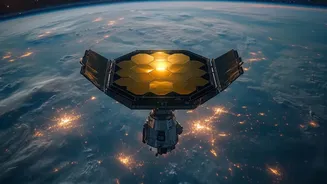
This is where infrared vision becomes a superpower. The Webb telescope was specifically designed to be highly sensitive to near- and mid-infrared light, allowing it to overcome both challenges. Its instruments can detect the faint, redshifted glow from the universe's first luminous objects. Furthermore, the longer wavelengths of infrared light can pass through the dense clouds of cosmic dust that would otherwise block our view. While the Hubble Space Telescope gave us stunning views in visible light, Webb's infrared capabilities reveal a hidden universe. It allows astronomers to see directly into the dusty cores of nascent galaxies and star-forming nebulae, providing a clear picture of processes that were previously obscured.
Galaxies More Mature Than Expected
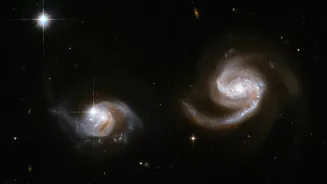
The clues Webb has gathered are already forcing scientists to rethink long-held theories about cosmic dawn. Models predicted that the first galaxies would be small, chaotic, and slowly assembling. Instead, Webb is finding galaxies that are surprisingly bright, large, and more structured than anticipated for their age. Some galaxies, seen as they were when the universe was less than a billion years old, already show dense, rotating discs of stars at their centers, a sign of maturity that astronomers thought took much longer to develop. This flood of discoveries suggests that the process of turning gas into stars may have been far more efficient in the early universe than our models had accounted for, or that galaxies began forming even earlier than previously believed.
Unveiling New Cosmic Mysteries
Beyond confirming that early galaxies were surprisingly advanced, Webb's infrared eyes are revealing entirely new types of celestial objects. Astronomers have been puzzled by numerous faint objects dubbed 'little red dots,' which are exceptionally bright in infrared light. Recent findings suggest some of these may be a new class of object altogether: a 'black hole star'. These are thought to be enormous clouds of gas, potentially the size of our solar system, with a supermassive black hole growing at their core. This could represent a crucial, previously unseen stage in the evolution of the supermassive black holes that anchor modern galaxies. In another discovery, Webb provided the first clear view of a pair of actively feeding supermassive black holes in a merging galaxy from just 1.3 billion years after the Big Bang, offering a direct look at how these giants grow.