



Why Sitting Is the Culprit
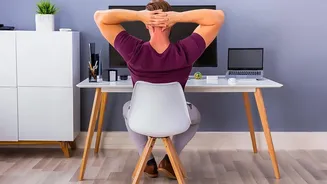
Our bodies are designed for movement. When you sit for hours, your hips are held in a flexed position. This causes the muscles at the front of your hips, known as the hip flexors, to become short and tight. At the same time, your glute muscles—which are meant
to be strong and support your pelvis—can become inactive or 'sleepy' from disuse. This combination of tight flexors and weak glutes creates a muscular imbalance that pulls on your pelvis, restricts your range of motion, and can even contribute to lower back pain. Over time, this pattern can lead to chronic stiffness and discomfort, making it feel difficult just to stand up straight.
1. Kneeling Hip Flexor Stretch
This classic stretch directly targets the tight muscles at the front of your hips. Start by kneeling on a soft surface like a mat or carpet. Step one foot forward so your knee is bent at a 90-degree angle, directly over your ankle. Your other knee should remain on the floor. Keeping your back straight and your core engaged, gently shift your hips forward until you feel a comfortable stretch along the front of the thigh of your back leg. Be careful not to arch your lower back; the movement should come from your hips. Hold this position for 20–30 seconds, breathing deeply. Then, switch legs and repeat on the other side. This stretch provides immediate relief by lengthening those shortened hip flexors.
2. Glute Bridge
After stretching the front of your hips, it's crucial to activate the opposing muscles: your glutes. The glute bridge is a simple but powerful exercise for this. Lie on your back with your knees bent, feet flat on the floor about hip-width apart, and your arms resting by your sides. Press through your heels and squeeze your glutes to lift your hips off the floor until your body forms a straight line from your shoulders to your knees. Avoid pushing so high that you arch your lower back. Pause for a moment at the top, focusing on the contraction in your glutes, then slowly lower your hips back down. Aim for 10–15 repetitions. This helps 'wake up' your glutes and restore balance to your pelvis.
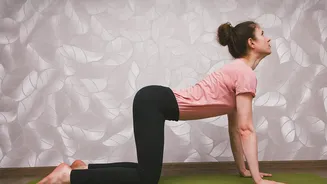
3. Cat-Cow Stretch
Stiffness in the hips is often connected to a stiff spine. The cat-cow stretch is a gentle way to improve spinal mobility and release tension in the lower back. Start on all fours with your hands directly under your shoulders and your knees under your hips. Inhale as you drop your belly towards the floor, lifting your chest and tailbone to create an arch in your back (the 'cow' position). Then, exhale as you press into your hands, rounding your spine up toward the ceiling and tucking your chin to your chest (the 'cat' position). Flow smoothly between these two positions for 8-10 repetitions, coordinating the movement with your breath.
4. Figure-Four Stretch
This stretch targets the deep hip rotator muscles and glutes, including the piriformis, which can get tight from sitting. Lie on your back with your knees bent and feet flat on the floor. Cross your right ankle over your left knee, creating a 'figure four' shape. If this is enough of a stretch, stay here. To deepen it, gently lift your left foot off the floor and loop your hands behind your left thigh, drawing your legs toward your chest until you feel a stretch in your right glute and hip. Keep your head and shoulders relaxed on the floor. Hold for 30 seconds, then switch sides.
Building a Consistent Routine
The key to lasting relief is consistency. You don't need a long, intense session to feel the benefits. Performing these gentle exercises for just 5–10 minutes each day can make a significant difference. Try doing them in the morning to start your day with more mobility or in the evening to undo the effects of a day spent sitting. Even better, take micro-breaks throughout your workday to perform one or two of these movements. Standing up and moving around for even a minute every hour can prevent stiffness from setting in.