







What is CAPSTONE?
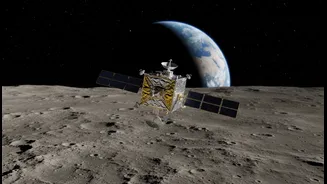
CAPSTONE, short for Cislunar Autonomous Positioning System Technology Operations and Navigation Experiment, is a 55-pound CubeSat launched in June 2022. While small in stature, its mission was enormous: to serve as a pathfinder for NASA's Artemis program.
Owned and operated by commercial partner Advanced Space for NASA, CAPSTONE's primary goal was to test a unique and challenging lunar orbit, proving it could be a safe and stable place for future missions, including the planned Lunar Gateway space station. After launching from New Zealand aboard a Rocket Lab Electron rocket, it took a long, efficient, four-month journey to reach the Moon, arriving in its operational orbit in November 2022. In June 2026, after completing all of its primary and extended goals, NASA concluded its activities with the highly successful mission.
Pioneering a Unique Lunar Orbit
The core of CAPSTONE’s mission was to fly in a Near-Rectilinear Halo Orbit (NRHO). Unlike the low, circular orbits of the Apollo missions, an NRHO is a highly elliptical, seven-day loop around the Moon. It swoops down to about 1,600 kilometers over one lunar pole before soaring out to 70,000 kilometers over the other. This special orbit is located at a gravitational balance point between the Earth and the Moon. This provides long-term stability, requiring minimal fuel for a spacecraft to maintain its position, a crucial factor for a long-term outpost like the Gateway. The NRHO also offers an uninterrupted line of sight to Earth for communications and continuous coverage of the lunar south pole, a key region of interest for future exploration. CAPSTONE was the very first spacecraft to successfully enter and operate in this orbit, verifying that the complex computer models were correct and that it is a viable and safe path for future spacecraft.
The Dawn of Autonomous Navigation
Beyond testing the orbit, CAPSTONE had another revolutionary goal: to demonstrate autonomous navigation in deep space. Historically, spacecraft have relied on constant communication with giant antennas on Earth—the Deep Space Network—to determine their exact location. CAPSTONE tested the Cislunar Autonomous Positioning System (CAPS), a cutting-edge technology designed to allow spacecraft to figure out where they are on their own. To do this, CAPSTONE communicated directly with NASA's Lunar Reconnaissance Orbiter (LRO), a satellite that has been circling the Moon since 2009. By sending signals to LRO and analyzing the return signal, CAPSTONE's software could calculate its own position and trajectory relative to LRO. This spacecraft-to-spacecraft navigation is a game-changer. It reduces reliance on the oversubscribed Deep Space Network, paving the way for a future where lunar missions can navigate more independently and efficiently.
The Impact on Artemis and Beyond
The success of CAPSTONE has been a monumental step forward for NASA's Artemis program and the future of lunar exploration. By validating the stability of the NRHO, it has significantly reduced the risk for the Lunar Gateway, the planned orbital station that will serve as a staging point for missions to the lunar surface and eventually Mars. The data gathered on propulsion and power needs to maintain the orbit provides invaluable real-world information for mission planners. Furthermore, the successful demonstration of the CAPS autonomous navigation system is a critical building block for creating a self-sufficient cislunar infrastructure. As more government, commercial, and international missions head to the Moon, this technology will be essential for managing traffic and ensuring safe operations without being tethered to Earth-based control. CAPSTONE proved that small, relatively low-cost commercial missions can provide immense value and pave the way for large-scale human exploration.