






Ever found yourself ordering tomato juice on a flight, even if you rarely touch it on the ground? You're not alone. There's a fascinating scientific reason why certain foods and drinks suddenly become more appealing at 35,000 feet.
Your Senses in a Pressurised Cabin
The moment you step
onto a plane, your body starts reacting to a completely different environment. The two biggest culprits that affect your senses are low pressure and low humidity. At cruising altitude, the cabin is pressurised to the equivalent of being 6,000 to 8,000 feet up a mountain. This drop in pressure, combined with air that is often drier than the Sahara desert with humidity below 15%, immediately begins to dry out your nasal passages. Since about 80% of what we perceive as flavour actually comes from our sense of smell, this dryness significantly dulls our ability to taste.
The Great Flavour Muting
It’s not just your sense of smell that takes a hit. The combination of low pressure and dryness directly affects your taste buds. A well-known study commissioned by German airline Lufthansa and conducted by the Fraunhofer Institute used a simulated aircraft cabin to test how flavour perception changes. The results were clear: our sensitivity to sweet and salty tastes can drop by as much as 30% in the air. This is why a meal that was perfectly seasoned on the ground can taste disappointingly bland on your tray table. Your perception of sour, bitter, and spicy flavours, however, remains largely unchanged.
Umami to the Rescue
While sweet and salty notes fade into the background, another taste profile takes centre stage: umami. Often called the 'fifth taste', umami is the savoury, rich, and meaty flavour found in foods like aged cheese, mushrooms, soy sauce, and, most famously, tomatoes. Unlike its sweet and salty counterparts, the perception of umami is not diminished by high altitude and low pressure. In fact, it remains stable and robust, cutting through the sensory fog. Tomatoes are packed with glutamic acid, the compound primarily responsible for umami, which is why tomato juice suddenly tastes so rich, complex, and satisfying during a flight.
The Surprising Role of Noise
Beyond pressure and humidity, there's another powerful factor at play: noise. The constant roar of a jet engine, which can reach around 85 decibels, has a curious effect on our palate. Research from institutions like Cornell University has shown that this level of background noise further suppresses our ability to detect sweetness. But here’s the twist: that same loud noise actually enhances our perception of umami. This phenomenon, sometimes called 'sonic seasoning', means the very sound of the plane is making your tomato juice taste even better. The loud drone essentially tricks your brain into focusing on the savoury notes that manage to break through the noise.
An In_Flight Culinary Strategy
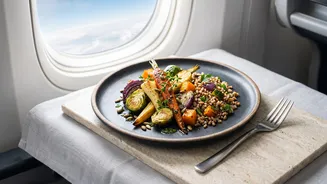
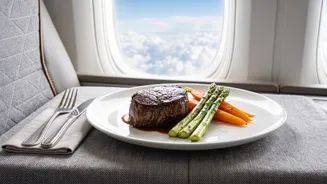
Airlines and their catering companies are well aware of this science. They intentionally design menus that can stand up to the challenging cabin environment. Chefs often increase seasoning and lean heavily on ingredients that are naturally high in umami to ensure meals don't taste flat. This is why you'll often find dishes featuring tomato_based sauces, mushrooms, parmesan cheese, or soy glazes on in_flight menus. They are not just choosing tasty ingredients; they are making a strategic choice to give passengers a more flavourful and enjoyable dining experience despite the sensory limitations of air travel.