






The Latest Successful Test
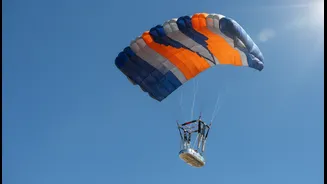
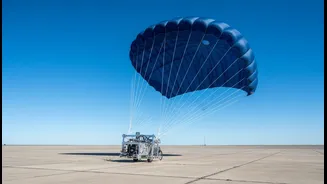
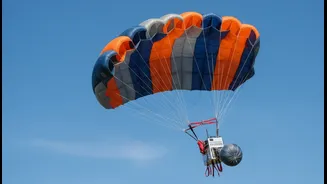
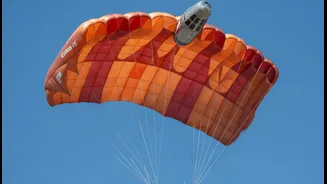
On July 8, 2026, the Indian Space Research Organisation (ISRO) successfully conducted the Integrated Main Parachute Airdrop Test (IMAT-05). This test, held in Madhya Pradesh, was designed to qualify the main parachute system under the maximum stress it
is expected to endure during a mission. During the trial, a payload simulating the crew module's weight was dropped from an Indian Air Force IL-76 aircraft at an altitude of 2.5 kilometres. The successful deployment and performance of the parachutes in this test provides immense confidence in the system's reliability for the first uncrewed Gaganyaan (G1) mission.
A Perfectly Choreographed Fall
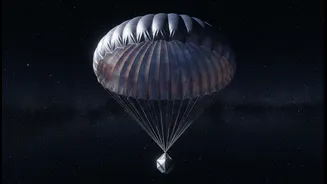
Bringing the Gaganyaan crew module back from orbit is a delicate and complex process that relies on a sequence of ten parachutes of four different types. The descent begins when the module is hurtling through the atmosphere at incredible speeds. First, two Apex Cover Separation parachutes deploy to remove the protective cover from the parachute compartment. This is immediately followed by two drogue parachutes, which are essential for stabilizing the capsule and dramatically reducing its velocity from supersonic speeds. Once the module is stable and slow enough, three smaller pilot parachutes pull out the three large main parachutes. These are the final brakes, slowing the capsule to a gentle speed of less than 11 meters per second for a safe splashdown in the ocean.
Surviving the Fiery Re-entry
The parachute system is arguably one of the most critical safety features of the entire Gaganyaan mission because of the extreme conditions it must operate in. When the crew module re-enters Earth's atmosphere, it is travelling at thousands of kilometres per hour, generating intense heat and pressure. The parachutes are shielded from this heat by an apex cover. After the most violent phase of re-entry, this cover is jettisoned, and the parachute deployment sequence must begin flawlessly. There is no room for error. The system must work perfectly after being subjected to the harsh environment of space and the trauma of atmospheric re-entry, making these qualification tests absolutely non-negotiable.
The Ultimate Safety Net for Astronauts
While the entire Gaganyaan mission is a technological marvel, the parachute system has a uniquely human focus: ensuring the survival of the astronauts, or 'Vyomanauts'. Every component is designed with redundancy in mind. For example, the system can still ensure a safe landing even if one of the three main parachutes fails to open. The recent successful tests are more than just engineering validation; they are a direct confirmation of the safety measures in place to protect the lives of the crew. This meticulous, safety-first approach is fundamental to human spaceflight and demonstrates India's capability to manage the immense responsibilities of a crewed mission.
What Comes Next on the Road to Orbit?
With the successful qualification of the parachute system, ISRO moves one step closer to the first uncrewed flight of the Gaganyaan program, known as the G1 mission. These uncrewed flights are designed to test every system in an integrated way, from launch to splashdown and recovery, before putting any astronauts on board. While timelines for human spaceflight are often subject to change to ensure maximum safety, these recent milestones keep the program on track for its eventual goal. The success of the parachute tests is a green light to proceed with the final integration stages for the uncrewed missions that will pave the way for India's historic first crewed flight.