

India’s Next Interplanetary Leap
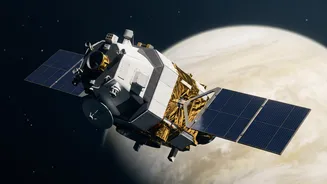
Following the resounding successes of Chandrayaan to the Moon and Mangalyaan to Mars, the Indian Space Research Organisation (ISRO) is setting its sights on our closest planetary neighbour. The Venus Orbiter Mission, popularly known as Shukrayaan, is India's
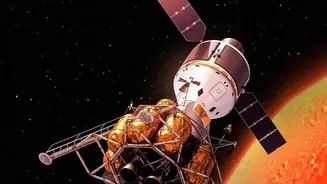
first dedicated mission to the second planet from the sun. Formally approved by the Indian government in September 2024, the mission is a major statement of intent, building on ISRO’s reputation for cost-effective and highly successful interplanetary exploration. With a scheduled launch date of March 29, 2028, aboard the powerful LVM-3 rocket, Shukrayaan represents the next frontier for Indian space science, aiming to unlock secrets that have eluded scientists for decades.
Why Venus? Earth's 'Evil Twin'
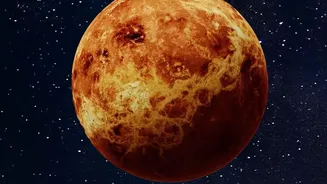
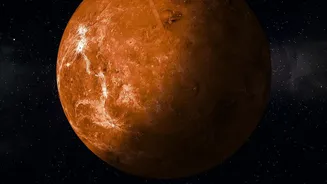
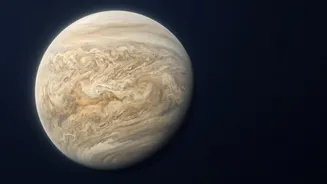
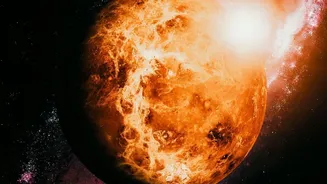
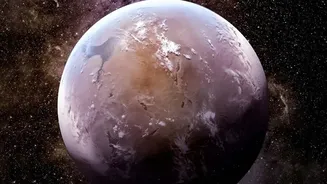
Venus is a planet of extremes. While similar to Earth in size, mass, and density, it evolved into the most hostile environment in the solar system. Its surface is scorched by temperatures of around 465°C, hot enough to melt lead, and the atmospheric pressure is over 90 times that of Earth's—equivalent to being a kilometre deep in the ocean. The planet is perpetually covered by thick, opaque clouds of corrosive sulfuric acid. Scientists are fascinated by this divergence. Understanding the runaway greenhouse effect that turned Venus into a hothouse could provide critical insights into Earth's own climate evolution and future risks, making the study of our 'evil twin' a crucial piece of the planetary science puzzle.
Peering Through the Veil with Radar
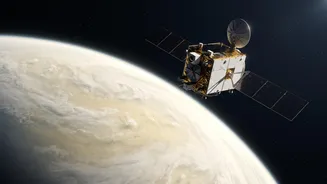
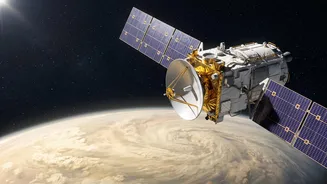
The single biggest challenge to studying Venus is its impenetrable cloud cover. To overcome this, Shukrayaan’s flagship instrument is a high-resolution Synthetic Aperture Radar (SAR). Unlike optical cameras, radar can pierce through the thick atmosphere, day or night, to map the surface below. This technology will allow ISRO to create detailed topographical maps of Venus, searching for evidence of active volcanoes, lava flows, and other geological features with a resolution expected to be four times greater than NASA's Magellan mission in the 1990s. In a world-first for Venus exploration, the orbiter will also carry a ground-penetrating radar, designed to study the planet's shallow sub-surface, offering a glimpse into its geological layers for the very first time.
Decoding the Corrosive Clouds
Beyond just looking through the atmosphere, Shukrayaan will carry a sophisticated suite of instruments to analyse its composition directly. The mission will carry a payload of about 100 kg, comprising 19 scientific instruments from India and international partners like Russia, Sweden, and Germany. These tools include thermal cameras, spectrometers, and sensors that will study the structure, chemistry, and dynamics of the atmosphere. Instruments like the Venus Thermal Camera and Venus Cloud Monitoring Camera will map temperature profiles and track wave phenomena and lightning—a largely unexplored aspect of Venusian weather. Another key instrument, the Venus InfraRed Atmospheric gases Linker (VIRAL), is a collaboration with Russia and France designed to study atmospheric gases and potentially confirm or deny the presence of phosphine, a gas that could be a tentative indicator of biological processes.
A Mission of Global Significance
Shukrayaan is not just an Indian mission; it is a global scientific endeavour. The collaboration with international space agencies like those of Sweden, Germany, and Russia highlights India's growing role as a trusted partner in space exploration. The mission's objectives align with a renewed global interest in Venus, with NASA and the European Space Agency also planning missions in the coming decade. By studying how solar wind interacts with the Venusian ionosphere and why the planet lost its water, Shukrayaan will contribute vital data to the collective understanding of how Earth-like planets can evolve so differently. This mission will place India among the elite club of nations that have explored Venus, cementing its status as a major force in deep space science.