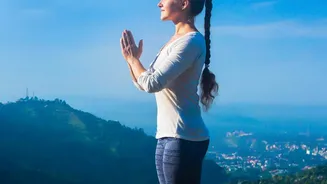





What Is Mountain Pose?
Tadasana, from the Sanskrit 'tada' (mountain) and 'asana' (pose), is the cornerstone of a standing yoga practice. While it appears simple, it is an active and dynamic pose that requires full-body engagement and mindfulness. Think of it as the reference
point for your body's optimal posture. It teaches the essential principles of grounding down while lengthening up, creating a stable base that improves alignment not just in other yoga poses, but in your daily life as well. By consciously practicing how to stand well, you build muscle memory that can help correct posture, improve balance, and increase body awareness.
The Subtle Power of Standing Still
The benefits of regularly practicing Mountain Pose extend far beyond the yoga mat. Physically, it strengthens the thighs, knees, and ankles, creating a more stable foundation for all movement. It has a toning effect on the legs and glutes and helps realign the spine, which can significantly improve posture over time. Mentally, the act of standing with intention promotes focus and calms the mind. It’s a grounding practice that can reduce stress and anxiety by drawing your attention inward to your breath and physical sensations. Research suggests that yoga practices that enhance stability, like Tadasana, can even reduce the risk of falls.
A Step-by-Step Guide to Tadasana
Finding your Mountain Pose is a process of stacking your joints and engaging your muscles with intention. Start by standing with your feet either together or hip-width apart, whichever feels more stable. Lift all ten toes, spread them wide, and then gently place them back on the mat. Distribute your weight evenly across all four corners of each foot: the base of the big toe, the base of the little toe, the inner heel, and the outer heel. Engage your thigh muscles to gently lift your kneecaps, but avoid locking your knees—keep a micro-bend to protect the joints. Draw your tailbone down slightly toward your heels to find a neutral pelvis, and gently engage your core by drawing your lower belly in and up. Let your arms rest by your sides, with palms facing forward to open the chest. Broaden your collarbones and relax your shoulders down and away from your ears. Lengthen your neck and lift through the crown of your head as if a string were gently pulling you taller. Keep your gaze soft and directed straight ahead. Hold for 5 to 10 deep breaths.
Common Mistakes to Avoid
Proper alignment is key to unlocking the benefits of Tadasana. A frequent mistake is locking the knees, which creates strain. Always maintain a slight, soft bend. Another common error is letting the chest collapse and the shoulders round forward—a habit many of us have from sitting at desks. Actively draw your shoulder blades down and together to keep the chest open. Also, be mindful of your weight distribution. Avoid leaning too far forward onto your toes or back onto your heels. The goal is to find an even balance. Finally, many people either over-arch or over-tuck their lower back. The aim is a neutral spine, which can be found by gently guiding the tailbone downward without flattening the natural curve of your lower back.
Modifications for Every Body
Mountain Pose should feel steady and accessible. If you feel unstable, stand with your feet hip-width apart for a wider, more solid base. For extra feedback on your alignment, practice with your back against a wall. Allow your heels, sacrum (the base of your spine), and shoulder blades to lightly touch the wall to feel a tall, straight line. If standing for long periods is difficult, you can practice a seated version in a chair. Sit tall with your feet flat on the floor, maintaining the same principles of a long spine and engaged core. For an added balance challenge, experienced practitioners can try closing their eyes to deepen their internal awareness.