
A Star's Ghostly Goodbye
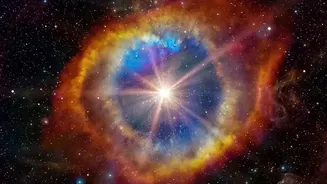
The subject of Webb’s gaze is the Helix Nebula, one of the most famous and relatively close examples of a planetary nebula. Despite the name, these objects have nothing to do with planets. Early astronomers, using less powerful telescopes, saw their round,
glowing shapes and thought they resembled gas giants. The reality is far more dramatic: a planetary nebula is the intricate, expanding shell of gas and dust shed by a star like our Sun at the end of its life. For nearly two centuries, we’ve pointed our best telescopes at the Helix Nebula, but Webb’s infrared capabilities have provided the clearest view yet, peering through layers of gas to reveal the complex physics at play. It’s the universe’s way of recycling, casting off stellar material that will eventually seed new stars and planets.
Unveiling 'Cometary Knots'
Webb’s new, high-resolution images bring an enigmatic feature into sharp focus: thousands of so-called “cometary knots.” These are dense clumps of gas and dust, each with a mass comparable to Earth but stretching for billions of miles, several times the size of Pluto's orbit. They aren’t actual comets, but from a distance, they resemble them with their bright heads and trailing tails. For years, their exact origin has been a subject of research. Webb's view helps clarify the process: as the dying star ejects its outer layers, blistering winds of hot, fast-moving gas from the core slam into cooler, slower-moving shells of material that were shed earlier. This cosmic collision sculpts the gas into the long, finger-like filaments that Webb has now imaged in unprecedented detail.
The Blueprint for a Dying Sun
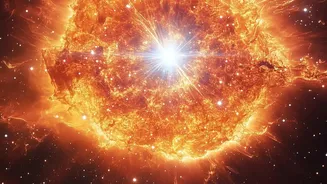
The reason the Helix Nebula is such a powerful crystal ball for our solar system is that the star at its center was once very similar to our own Sun. The life cycle for these medium-sized stars is well understood. After billions of years of calmly fusing hydrogen into helium, the fuel in the core begins to run out. The core will shrink and heat up, while the star's outer layers will swell dramatically, transforming it into a red giant. In about five billion years, our Sun will undergo this change, expanding so much it will engulf Mercury, Venus, and possibly even Earth. Following this phase, the Sun will shed its bloated outer layers into space over thousands of years.
Our Solar System's Distant Epilogue
After the red giant phase, the Sun's story becomes a mirror of the Helix Nebula. The expelled gas and dust will form a vast, glowing planetary nebula. At the center, the star's tiny, incredibly hot and dense core—a white dwarf—will remain. The intense ultraviolet radiation from this white dwarf will light up the expanding clouds of gas, causing them to fluoresce in brilliant colors, just as we see in the images from Webb. The different colors in Webb's new image represent the temperature and chemistry of the material, from hot ionized gas near the core to cooler molecular hydrogen and dust at the edges. This process will be our Sun’s final, beautiful act, creating a celestial monument visible across the galaxy for about 10,000 years before it fades.