





The Definition of Free Sugars
Before comparing honey and sugar, it's important to understand what 'free sugars' are. According to global health bodies like the World Health Organization (WHO), free sugars include any sugar added to food by the cook, manufacturer, or consumer. Crucially,
this definition also includes sugars naturally present in honey, syrups, and fruit juices. This is because, once removed from their natural source (like the cell wall of a whole fruit), these sugars behave similarly in the body to added sugars. Therefore, from a health perspective, the sugar in honey is classified the same way as the sugar you spoon into your tea.
A Tale of Two Sugars: Composition
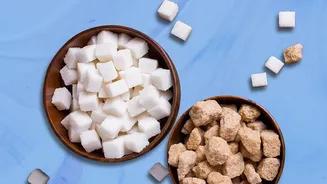
Table sugar, or sucrose, is a simple molecule made of 50% glucose and 50% fructose bonded together. Our bodies must break this bond before we can use the energy. Honey, on the other hand, is a more complex substance. It's primarily composed of separate glucose (about 30%) and fructose (about 40%) molecules, with the rest being water and small amounts of other compounds. Because the sugars in honey are already separated, they are absorbed more directly by the body. This fundamental structural difference is key to how each sweetener is processed.
The Calorie and Sweetness Comparison
Here's where things get a bit counterintuitive. Gram for gram, sugar contains fewer calories than honey. However, we usually measure by volume, like a teaspoon or tablespoon. Because honey is denser than granulated sugar, a tablespoon of honey actually contains more calories and sugar than a tablespoon of sugar. For instance, a tablespoon of honey has around 64 calories, while a tablespoon of sugar has about 49. The trade-off is that honey is generally perceived as being sweeter than sugar, largely due to its higher fructose content. This might lead some people to use less honey to achieve the same level of sweetness, potentially balancing out the calorie difference.
Impact on Blood Sugar: The Glycemic Index
The Glycemic Index (GI) measures how quickly a food raises blood sugar levels. Pure glucose has a GI of 100. Table sugar (sucrose) typically has a GI of around 65. The GI of honey is more variable, depending on its floral source, but generally ranges from 45 to 64. While many types of honey have a lower GI than sugar, some can be higher. This means honey often raises blood sugar a bit more gradually than table sugar, but the difference is modest. For anyone managing blood sugar levels, both should be considered concentrated sources of sugar and consumed with caution.
Beyond Sugar: The Nutritional Edge of Honey
This is where honey pulls ahead. Refined table sugar offers 'empty calories' with no additional nutritional value. Raw honey, in contrast, contains trace amounts of vitamins, minerals, enzymes, and amino acids. It is also known to contain antioxidants, such as flavonoids, which have anti-inflammatory properties. Some research suggests honey may have antibacterial properties and can help soothe coughs. However, it's important to keep this in perspective. The amounts of these beneficial compounds in a typical serving of honey are very small and unlikely to make a major impact on your overall nutrient intake.