






An Invisible Cosmic Threat
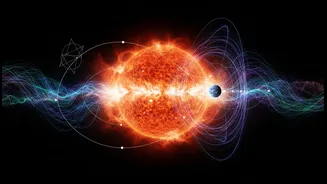
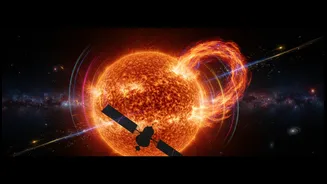
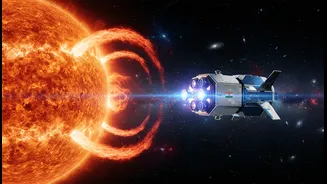
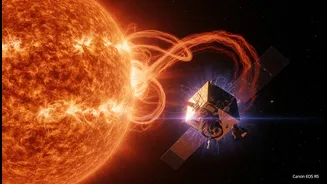
Space weather refers to the changing conditions in space driven by the Sun. The Sun constantly releases a stream of charged particles called the solar wind. But sometimes, it unleashes more violent events like solar flares (intense bursts of radiation)
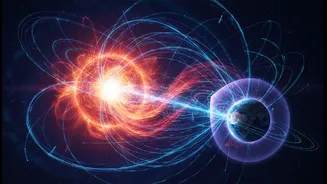
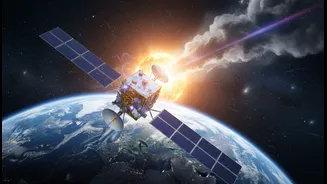
and coronal mass ejections (CMEs), which are massive clouds of plasma and magnetic fields hurled into space. While Earth’s magnetic field protects us from most of this onslaught, intense solar storms can overwhelm our defences, posing a significant risk to technology, especially satellites orbiting beyond the atmosphere's protection.
Satellites in the Firing Line
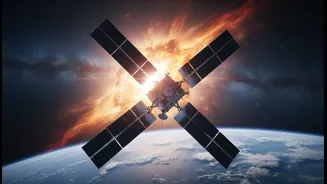
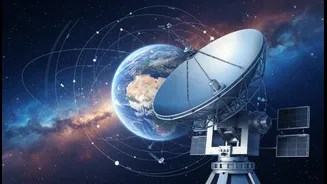
Space weather impacts satellites in four main ways. First, it heats and expands Earth's upper atmosphere, increasing drag on satellites in Low Earth Orbit (LEO). This can cause them to lose altitude and even burn up prematurely. A famous example occurred in February 2022, when a relatively minor geomagnetic storm caused SpaceX to lose up to 40 new Starlink satellites. Second, high-energy particles can damage or degrade crucial hardware like solar panels and electronic circuits, causing malfunctions or shortening a satellite's lifespan. Third, storms can cause electrostatic charges to build up on a satellite's surface, leading to discharges that can fry sensitive electronics. Finally, space weather disrupts the signals used for communication and navigation, affecting services like GPS and delaying data transmission to ground stations.
India’s Growing Stake in Space
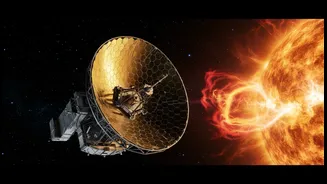
For India, the stakes are higher than ever. The Indian Space Research Organisation (ISRO) operates a vast constellation of satellites for communication, Earth observation, and navigation through its NavIC system. The nation’s burgeoning digital economy, defence capabilities, and disaster management systems are deeply reliant on this space infrastructure. Furthermore, India’s private space sector is rapidly expanding, with numerous startups planning to launch their own satellite constellations. As India’s presence in space grows, so does its vulnerability to solar tantrums. Recognising this, ISRO is actively monitoring space weather with its Aditya-L1 solar observatory, which provides crucial data on solar events, and ground-based networks like INSWIM.
A New Frontier for Careers
The growing threat of space weather is creating a new and exciting job market. The space industry can no longer just launch satellites; it must actively manage and protect them from this dynamic environment. This has opened doors for a range of specialised careers. There is a rising demand for space weather forecasters, who analyse solar data to predict and issue warnings about incoming storms. Data scientists and software developers with skills in Python and machine learning are needed to build predictive models and analyse vast datasets from solar observatories. Physicists and researchers are essential for deepening our fundamental understanding of the Sun-Earth connection.
Building a Career in Space Weather
For students and professionals in India looking to enter this field, the path involves a strong foundation in science and technology. Degrees in physics, aerospace engineering, computer science, and mathematics are highly relevant. Specialised knowledge in areas like plasma physics, astrophysics, and data analysis is particularly valuable. Institutes like the Indian Institute of Space Science and Technology (IIST), the Indian Institute of Geomagnetism (IIG), and the Aryabhatta Research Institute of Observational Sciences (ARIES) are at the forefront of space science education and research in the country. Organisations like ISRO also offer Junior Research Fellowships and other project-based roles that provide a direct entry point into studying and forecasting space weather's impact.