

First, What Is a Super-Earth?
Before we dive into how Webb finds water, it's important to understand where it's looking. The term 'super-Earth' might sound like a bigger, better version of our home, but it's a simple classification for an exoplanet—a planet outside our solar system.
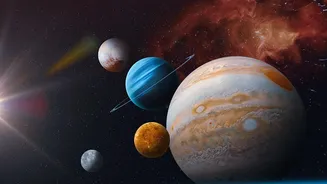
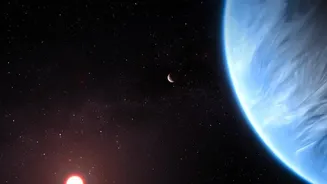
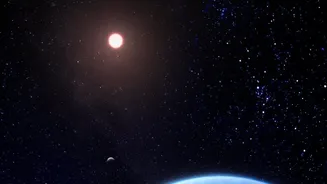
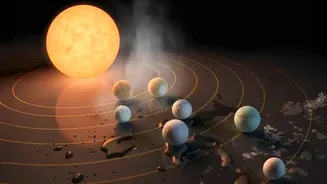
These worlds are more massive than Earth but lighter than our ice giants like Neptune. They represent a class of planet we don't have in our own cosmic neighbourhood, yet they appear to be incredibly common throughout the galaxy. Super-Earths can be rocky like our world, gaseous like 'mini-Neptunes', or a combination of both. Some, like GJ 9827 d, are scorching hot 'steam worlds', while others orbit within their star's habitable zone, where conditions might be right for liquid water to exist. This variety makes them fascinating targets in the hunt for life.
Webb’s Secret Weapon: Seeing in Infrared
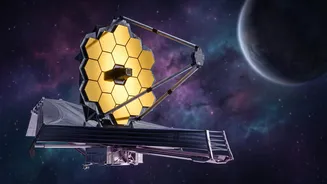
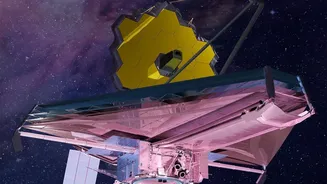
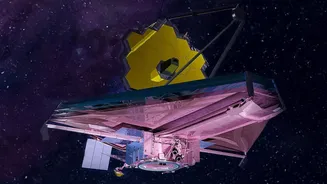
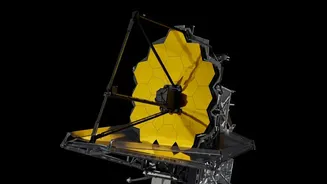
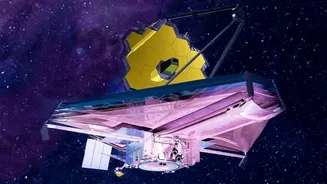
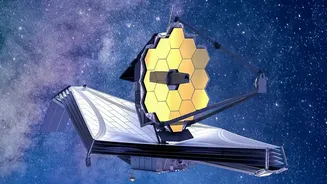
The James Webb Space Telescope's revolutionary power comes from its ability to see the universe in infrared light. This is light that is invisible to the human eye, but it holds a treasure trove of information. Webb is equipped with a suite of highly sensitive instruments designed to capture this light, including the Near-Infrared Spectrograph (NIRSpec), the Near-Infrared Imager and Slitless Spectrograph (NIRISS), and the Mid-Infrared Instrument (MIRI). These instruments act like cosmic prisms, but instead of just splitting visible light into a rainbow, they can spread a star's infrared light into thousands of precise shades. It is within this infrared spectrum that molecules essential for life, such as water vapor, methane, and carbon dioxide, leave their most distinct and detectable signatures. This capability allows Webb to perform a kind of long-distance chemical analysis on worlds that are hundreds of light-years away.
The Shadow Play of Transit Spectroscopy
The primary method Webb uses is called transit spectroscopy. Astronomers patiently wait for an exoplanet to transit, or pass in front of, its host star from our point of view. As the planet makes this journey, a tiny fraction of the starlight shines directly through the planet’s atmosphere, if it has one. This brief moment is when Webb’s instruments get to work. They capture the starlight that has been filtered through the alien air. By comparing the light from the star before, during, and after the transit, scientists can isolate the light that has interacted with the planet's atmosphere. This technique essentially uses the planet’s own atmosphere as a lens, imprinting information about its chemical composition onto the starlight that passes through it. This process has been a game-changer, turning tiny, distant dots of light into subjects for detailed atmospheric study.
Decoding an Atmosphere’s Barcode
When starlight passes through an atmosphere, the different gases present absorb very specific wavelengths, or colours, of that light. Every molecule has a unique chemical fingerprint—a pattern of light that it soaks up. Water (H2O), for instance, absorbs infrared light at very particular wavelengths. When Webb’s spectrographs split the filtered starlight into its full spectrum, these absorbed wavelengths appear as dark lines or dips. The resulting pattern looks like a barcode. By analyzing this 'barcode,' scientists can identify exactly which molecules are present. A dip at a specific point in the infrared spectrum acts as a distinct signature telling astronomers, "Water was here." The strength of that signal can even help them estimate the amount of water vapor present and the temperature of the atmosphere. It's this painstaking analysis that turns a stream of light into a profound discovery.
From Light Signatures to Water Discovery
The detection of water on planets like GJ 486 b and GJ 9827 d showcases this process in action. For GJ 486 b, a rocky super-Earth with a surface temperature of 430 degrees Celsius, Webb’s NIRSpec instrument detected a signal almost certainly due to water. While scientists are cautious, noting the signal could potentially come from cool spots on the star itself, the finding indicates that even hot, rocky planets might be able to hold onto an atmosphere. The confirmation of water on GJ 9827 d marked a milestone as the smallest exoplanet to date with a confirmed water-rich atmosphere. These discoveries are more than just isolated findings; they serve as a crucial proof of concept. They demonstrate that Webb has the power to detect the building blocks of life on smaller, rockier worlds—the very planets that are the primary targets in the search for habitable environments beyond our own.