




The Old Story: A Chaotic Beginning
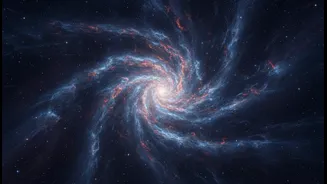
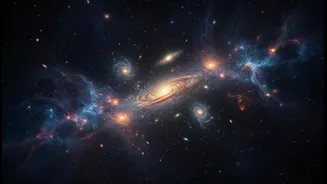
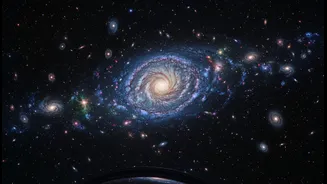
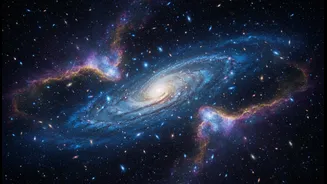
The long-held story of our universe’s childhood was one of beautiful chaos. According to standard models, after the Big Bang, matter slowly clumped together under the influence of gravity. The first galaxies were thought to be small, lumpy, and disorganized,
smashing into each other over billions of years to form the grand, structured spirals and ellipticals we see today, like our own Milky Way. The conventional wisdom was that complex structures took a very long time to appear. The universe, in this view, had to crawl before it could walk, assembling itself piece by messy piece.
A Surprise from the Cosmic Dawn
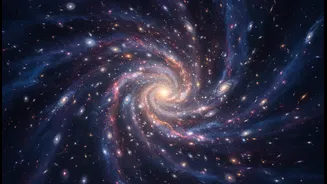
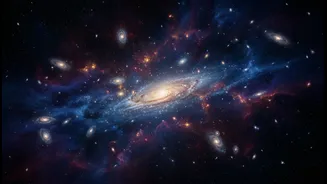
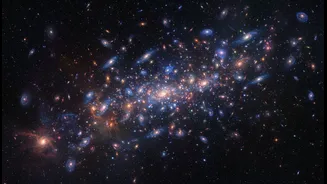
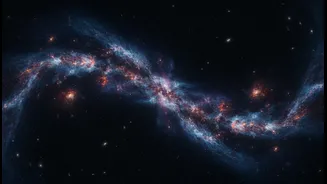
Recent discoveries, primarily from the James Webb Space Telescope (JWST), have thrown a fascinating wrench into this narrative. Astronomers are now finding galaxies with surprisingly complex and organised features at a time when the universe was just a few billion years old, or even younger. One of the most significant findings involves the discovery of a 'nuclear disc'—a dense, star-forming structure at the heart of a galaxy seen as it was more than nine billion years ago. Previously, such structures were only known to exist in nearby, fully mature galaxies. Finding one so early suggests that some galaxies weren't messy toddlers but were already developing sophisticated internal systems much faster than anyone predicted.
How Webb Rewrote the Story
The game-changer is the James Webb Space Telescope. Its unparalleled sensitivity and ability to see in infrared light allow it to peer back across billions of years to the cosmic dawn. By capturing the faint light from these incredibly distant objects, Webb can see galaxies as they existed in the distant past. In a recent discovery led by researchers from Durham University, astronomers used Webb to study a distant galaxy and found it already contained a stellar bar—a long structure of stars that funnels gas toward the galactic center. This bar had already built the compact nuclear disc at its core, a key process in galaxy evolution that was thought to happen much later. This isn't just about one galaxy; it's part of a growing pattern of evidence showing the early universe was home to more massive and structured galaxies than expected.
Rethinking the Galactic Blueprint
These findings are forcing a major rethink of galaxy formation theories. The presence of features like nuclear discs and stellar bars so early on challenges the idea that galaxies grow slowly and chaotically. It suggests that the internal processes that shape galaxies—what astronomers call 'secular evolution'—were already at work just a few billion years after the Big Bang. This has profound implications. For one, these organised central structures are believed to be crucial for feeding the supermassive black holes that lurk at the centre of most galaxies. Understanding when these structures form could help explain how these black holes grew so massive so quickly. The discovery implies that the universe might have been far more efficient at building complex structures from the very beginning.