


Beyond Just Finding Water
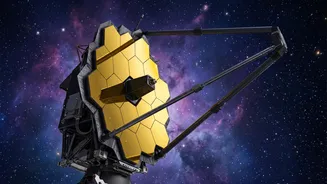
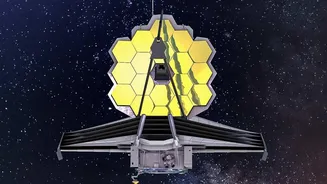
For years, finding the chemical signature of water on a distant exoplanet was a monumental achievement. But the James Webb Space Telescope is pushing the boundaries of what’s possible. Recent detailed surveys of exoplanet atmospheres are providing not
just confirmation of water, but a deeper understanding of its state. This isn't a single, brief observation but rather a methodical, in-depth analysis of the light filtering through these alien skies. The term "deep-field survey," traditionally used for imaging distant galaxies, is being applied metaphorically to describe the sheer depth and detail of these new atmospheric studies. It’s a shift from asking “Is there water?” to “What is this water like?”
How Webb Reads an Alien Atmosphere
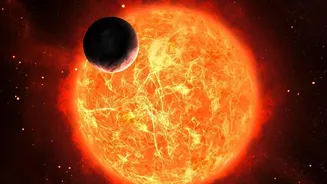
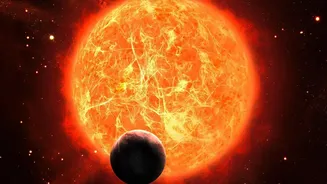
The JWST uses a technique called transmission spectroscopy to probe these faraway worlds. When an exoplanet passes in front of its host star from our perspective, a tiny fraction of the starlight shines through the planet's atmosphere. Different molecules in that atmosphere absorb specific colours, or wavelengths, of light, leaving a unique chemical fingerprint. The telescope's powerful infrared instruments are exceptionally sensitive to the signature of water. By analysing which colours of light are missing, astronomers can determine the presence of water vapour, its temperature, and even identify different forms of water molecules. This allows scientists to create the most detailed atmospheric profiles of exoplanets to date.
A Tale of Two Waters
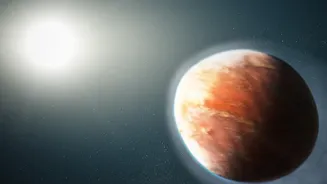
One of the most exciting recent developments is the detection of "semi-heavy water" (HDO) in an exoplanet's atmosphere for the first time. This molecule contains a heavier version of hydrogen called deuterium. Studying the ratio of heavy water to regular water (H2O) can provide crucial clues about how a planet formed and where its water originated. For instance, on the hot, gassy exoplanet WASP-39b, located nearly 700 light-years away, JWST's detailed spectrum allowed scientists to begin this type of analysis. While WASP-39b is a scorching gas giant and not a candidate for life, proving that JWST can detect such subtle variations is a massive technical achievement. It demonstrates a capability that will be essential when studying smaller, rocky worlds.
The Challenge of Rocky Worlds
Detecting atmospheres on rocky exoplanets is much harder than on large gas giants. Yet, this is a critical step in the search for habitable environments. The JWST has recently found tantalising hints of water vapour around rocky planets like GJ 486 b. However, scientists are cautious, as the water signature could potentially originate from cool spots on the host star itself, rather than the planet. Disentangling these signals is a major challenge. If confirmed to be from the planet, it would suggest the world has an atmosphere despite its scorching 430°C surface temperature, possibly sustained by volcanic activity. These ongoing investigations are test runs for the ultimate goal: analysing an Earth-like planet in its star's habitable zone.
From 'Steam Worlds' to Sand Clouds
The diversity of worlds Webb is uncovering is staggering. On one exoplanet, GJ 9827 d, the atmosphere appears to be composed almost entirely of hot water vapour, earning it the nickname "steam world." On another, WASP-107b, astronomers found not only water vapour and sulfur dioxide but also clouds made of silicate sand. These findings are reshaping our understanding of planetary formation and evolution. Each detailed survey provides a new piece of the puzzle, showing that the conditions on exoplanets are far more varied and complex than previously thought. The data from JWST is helping to refine theoretical models, moving them from simple assumptions to complex, realistic simulations of alien environments.