


A Landmark Discovery
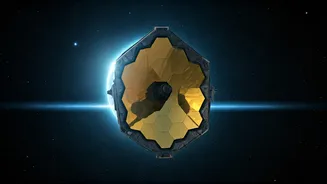
The James Webb Space Telescope (JWST) has confirmed the presence of key molecules, including water vapour, in the atmosphere of the exoplanet K2-18 b. Located 124 light-years away in the constellation Leo, this planet has become a prime target for astronomers
searching for potentially habitable worlds beyond our solar system. Initial observations hinted at a world rich in carbon-bearing molecules like methane and carbon dioxide, but the confirmation of water vapour strengthens the case that this distant world could possess a crucial ingredient for life as we know it. This is not just any detection; it’s a detailed look into the chemical makeup of a world orbiting another star, made possible by the unprecedented power of the JWST.
Meet the 'Hycean' World
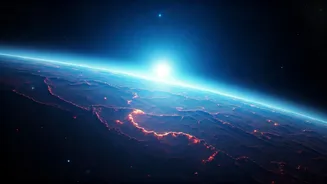
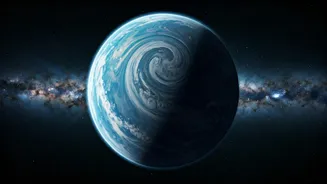
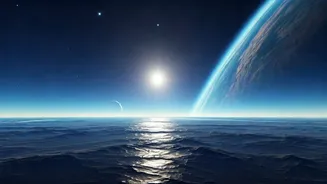
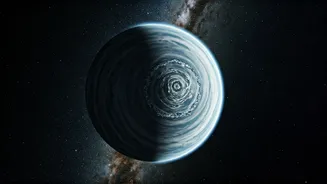
K2-18 b is what scientists call a 'sub-Neptune'—larger than Earth but smaller than Neptune, with about 8.6 times Earth's mass. More excitingly, it's a leading candidate for a new class of planet called a 'Hycean' world. This term, a blend of 'hydrogen' and 'ocean', describes a hypothetical planet covered by a globe-spanning liquid water ocean beneath a hydrogen-rich atmosphere. The presence of methane and CO2, coupled with a lack of ammonia, strongly supports the theory that K2-18 b could indeed have a water ocean. These conditions make Hycean worlds tantalizing targets, as they might offer habitable environments over a wider range of conditions than rocky, Earth-like planets.
How Webb Saw the Unseeable
Detecting the faint chemical whispers from a planet 124 light-years away is a monumental technical achievement. JWST uses a technique called transit spectroscopy. As K2-18 b passes in front of its host star, a tiny fraction of the starlight filters through the planet's atmosphere. Different molecules in the atmosphere absorb specific wavelengths of this light, leaving behind a unique chemical fingerprint. By analysing this altered starlight, scientists can decode the atmospheric composition. The telescope's exquisite sensitivity allows it to pick up on these minute changes, revealing the presence of water vapour, methane, and other gases that offer clues about the planet's nature.
More Than Just Water
While water is exciting, the JWST found something even more intriguing: a possible hint of dimethyl sulfide (DMS). On Earth, DMS is a gas produced almost exclusively by life, primarily marine phytoplankton. This raised the tantalising possibility that K2-18 b might not just be habitable, but inhabited. However, scientists are extremely cautious. The DMS signal is tentative and has been disputed by other research teams analysing the same data. While the initial team believes a life-filled Hycean world is the scenario that best fits all the data, they stress that more observations are needed to move from a tantalising hint to a confirmed discovery. This ongoing scientific debate highlights the challenge and rigour involved in such a profound search.
Not a Second Earth (Yet)
It's crucial to manage expectations. Finding water vapour and potential biosignatures does not mean we've found a lush, Earth-like paradise. K2-18 b is a 'super-Earth' or 'mini-Neptune', significantly larger and more massive than our world. Its hydrogen-rich atmosphere is very different from our nitrogen-oxygen mix. Furthermore, some models suggest that planets of this type could experience a runaway greenhouse effect, making their oceans too hot to support life as we know it. While K2-18 b orbits in its star's habitable zone—the region where liquid water could exist—the actual conditions on its surface remain a mystery. The journey from 'potentially habitable' to 'inhabited' is a long one, requiring much more evidence.
What Comes Next in the Search?
The findings from K2-18 b are a beginning, not an end. Scientists are already planning follow-up observations with JWST to confirm the DMS detection and get a clearer picture of the planet's atmosphere. These studies will help refine models of Hycean worlds and determine if K2-18 b is truly a water world. Researchers are also using other methods, like searching for radio 'technosignatures', to study the system, though none have been found so far. Each new piece of data not only tells us more about this specific planet but also hones the techniques we use to search for life elsewhere. K2-18 b has established itself as a natural laboratory for understanding potentially habitable worlds, pushing the boundaries of what we can learn about the cosmos.