






Meet the Galaxy's Cosmic Cannonball
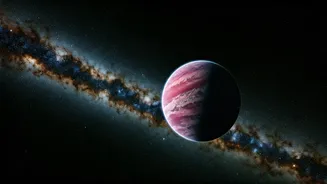
First, the basics. HD 80606 b is a gas giant exoplanet located about 217 light-years away in the constellation Ursa Major. It’s a behemoth, clocking in at around four times the mass of Jupiter, our solar system's own giant. Discovered back in 2001, it belongs
to a class of planets called “Hot Jupiters,” which are massive gas worlds orbiting close to their stars. But as scientists are now confirming with incredible new detail, HD 80606 b is not your typical Hot Jupiter. In fact, it might just be one of the most extreme planets ever observed.
An Orbit That Breaks All The Rules
What makes this planet so bizarre is its orbit. Instead of a relatively circular path like the planets in our solar system, HD 80606 b travels on a wildly eccentric, 111-day journey around its star. Think less of a planet and more of a cosmic cannonball or a comet. For most of its orbit, it stays far away from its star, in a region where it would receive sunlight similar to Earth. But then, for a very brief and violent period, its path brings it incredibly close to its star—much closer than Mercury is to our sun—before flinging it back out into the cold depths of its system. This path is one of the most elongated, or eccentric, ever discovered.
What Happens During the 'Flash-Heating'
That dramatic swing in distance creates hellish conditions. As the planet makes its closest approach, known as periastron, it gets absolutely roasted. In the span of just a few hours, the side of the planet facing the star experiences a radical temperature spike. Early observations from the Spitzer Space Telescope first detected this, showing the temperature rocketing from about 527 degrees Celsius to over 1,200 degrees Celsius. This sudden blast of radiation is thought to trigger planet-wide shockwaves and supersonic storms, creating weather phenomena unlike anything in our own solar system. Scientists have described it as watching one of the fiercest storms in the galaxy unfold in real time.
Why Now? The Webb Telescope Gets Involved
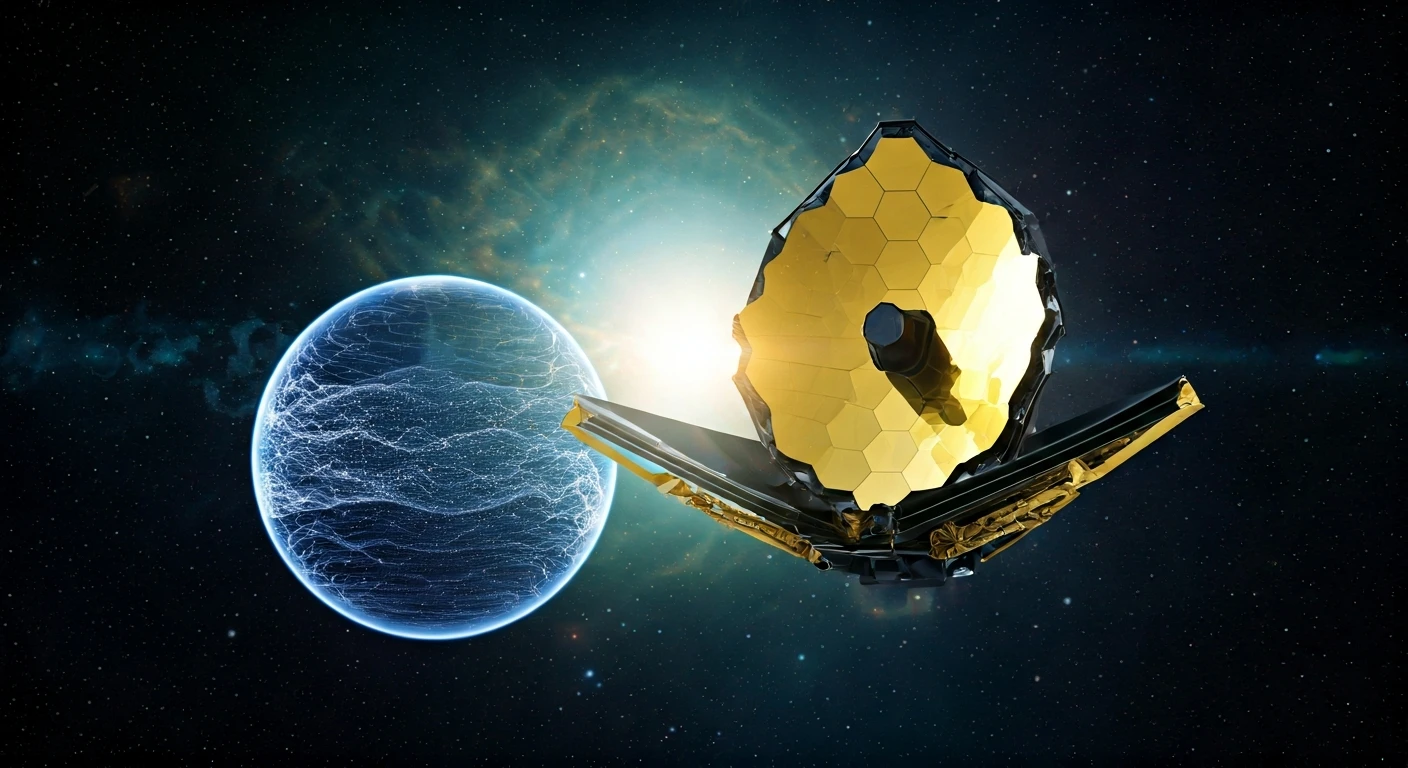
So why is this planet suddenly trending? The answer is the James Webb Space Telescope (JWST). The powerful new observatory recently turned its infrared eyes on HD 80606 b, observing it before, during, and after its fiery plunge. This was a complex observation to schedule, years in the making due to the planet's odd orbit and Webb's own viewing constraints. The ten-billion-dollar investment in Webb's technology allows for an unprecedented look at the planet's atmosphere, using spectroscopy to read the chemical signatures present in the light it emits. The data coming back is so rich that scientists say they are just getting started in deciphering what it all means.
A Glimpse Inside an Alien Storm
The latest findings, presented in June 2026 at the American Astronomical Society meeting, confirm that the reality is even more extreme than predicted. Webb's observations show the temperature increase is a staggering 1,100 degrees Fahrenheit (about 600 degrees Celsius). More importantly, Webb's Mid-Infrared Instrument (MIRI) is detecting how the planet's atmospheric chemistry changes in response to this flash-heating. Scientists are seeing the signatures of different molecules appear and disappear, giving them a play-by-play of the chemical reactions triggered by the intense radiation. This is a crucial step in understanding how atmospheres on even the most extreme worlds function.
Why This Extreme Planet Matters
Studying a world as volatile as HD 80606 b isn't just about cosmic sightseeing. Extreme examples are invaluable for scientists because they push theoretical models to their limits. By observing how this planet’s atmosphere and chemistry react under such intense conditions, researchers can refine their understanding of planetary physics in ways that a more 'normal' planet wouldn't allow. According to researchers, the efficiency of observing this planet is a major benefit; its wild orbit allows them to gather data under hugely varying conditions in just a few hours. These findings can then be applied to better understand the thousands of other exoplanets we have discovered, including those that might be more hospitable.