





The Flickering ‘Corona’ of a Black Hole
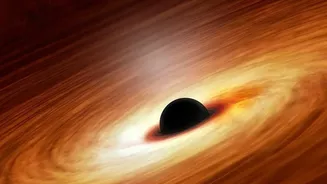
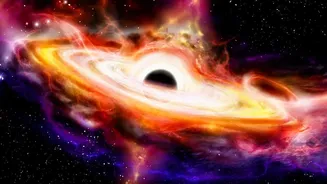
Imagine a black hole not as a simple void, but as the center of a chaotic, swirling system. As gas and dust are pulled in by its immense gravity, they form a superheated, spinning disk of material called an accretion disk. Just above this disk, and perilously
close to the point of no return, is an even hotter region of particles called the corona. With temperatures reaching a billion degrees, this corona glows intensely in X-ray light. However, this glow isn't steady. Scientists have long known the corona can change, but the specifics have been a mystery. Think of it as trying to understand a flickering lamp from millions of light-years away. For the first time, a long-term study has provided a movie, rather than a snapshot, of this behavior.
What Is a Radiation Shift?
A 'radiation shift' in this context refers to the dramatic changes in the brightness and location of the X-rays coming from the corona. For years, astrophysicists observed these coronas flaring up and dimming down, sometimes by a factor of 100 in just a few hours. In one incredible event, a black hole's corona completely disappeared, only to rebuild itself over several months. Scientists theorized these shifts were caused by the corona itself moving or changing in size—perhaps collapsing inward before being shot away from the black hole. These shifts are crucial because they directly relate to how a black hole feeds and grows, and how it blasts energy out into its host galaxy.
A Ten-Year Cosmic Watch
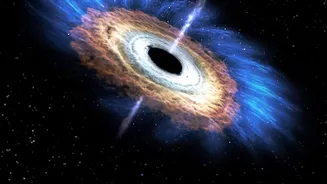
Observing these rapid changes requires patience and powerful tools. Over the last decade, astronomers have combined the capabilities of multiple X-ray observatories, such as NASA's Swift and NuSTAR telescopes, and the ESA's XMM-Newton. By dedicating thousands of hours of observation time, they could perform a kind of cosmic stakeout. One long-running observation campaign focused on a black hole known as XJ1500+0154, which has been flaring for over a decade since a star was first observed being torn apart by its gravity in 2005. In another case involving a black hole named 1ES 1927+654, researchers watched its corona vanish and then reappear after a suspected interaction with a stray star. These long-term projects allow scientists to piece together the entire lifecycle of these violent events.
What the Shifting Light Revealed
The decade of data confirmed long-held theories: the corona is a dynamic, not a static, feature. By linking the 'echoes' of X-ray light as they bounced off the accretion disk, scientists could map the corona's changing shape and size. The observations of 1ES 1927+654, for instance, showed the corona being destroyed and then rebuilding itself, providing the first real-time look at this process. This helped establish a clearer timeline for how a black hole recovers from a major disturbance, like a star falling into it. More recent studies using X-ray polarization have even started to reveal the corona's shape, suggesting it is an extended layer aligned with the accretion disk rather than a simple sphere.
Why This Cosmic Detective Work Matters
Understanding the corona is about more than just one exotic feature. The energy blasted out by the corona can influence star formation across an entire galaxy. By figuring out how and why the corona shifts its radiation, scientists can refine their models of how black holes and galaxies evolve together. These long-term studies transform our view of black holes from static objects to dynamic, ever-changing engines at the heart of galaxies. Each flicker and flare, tracked over years from billions of kilometres away, provides another clue to understanding the most extreme and powerful phenomena in our universe.