


The Next Giant Leap: Gaganyaan
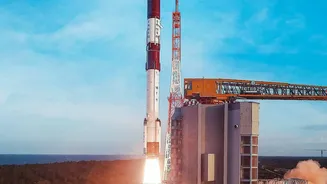
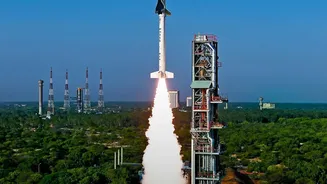
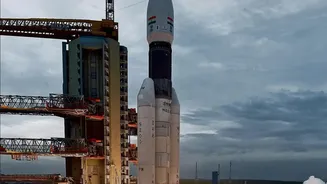
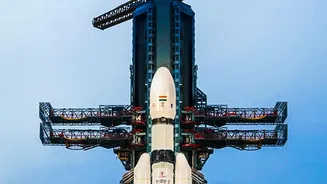
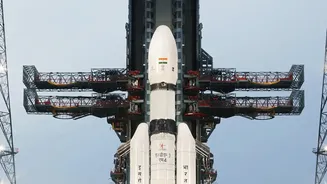
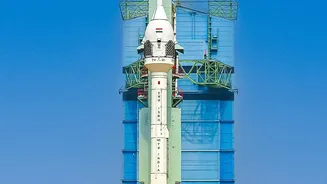
The single most ambitious project on ISRO's roster is Gaganyaan, India's inaugural human spaceflight mission. The goal is to demonstrate the capability to send a crew of up to three astronauts into a Low Earth Orbit of about 400 kilometres and bring them
back safely. The first uncrewed test flight, Gaganyaan G1, is planned for the latter half of 2026. This will be followed by a second uncrewed mission featuring the humanoid robot Vyommitra before the first crewed flight, potentially in 2027. Successful qualification tests of crucial systems, like the crew module's floatation and umbilical separation mechanisms, were recently completed in July 2026, marking steady progress. Gaganyaan is more than a mission; it's a foundation for a sustained Indian human presence in space, making India only the fourth nation to possess this independent capability.
An Eye on the Sun: Aditya-L1's Vigil
While launched in September 2023, the Aditya-L1 mission represents ISRO's ongoing presence far beyond Earth. It is India’s first space-based observatory dedicated to studying the Sun. The spacecraft is positioned in a halo orbit around the Lagrange point 1 (L1), about 1.5 million km from Earth, giving it an uninterrupted view of our star. Its mission is to observe the Sun's corona, chromosphere, and solar winds. By studying phenomena like Coronal Mass Ejections (CMEs), which can disrupt space weather and satellite communications, Aditya-L1 provides crucial data for understanding the Sun's impact on our technological infrastructure. The mission has already begun delivering valuable scientific data and is a testament to ISRO's expanding scientific portfolio.
Revisiting the Red Planet: Mangalyaan-2
Building on the phenomenal success of its first Mars Orbiter Mission (MOM), ISRO is planning a more complex successor, Mangalyaan-2. Unlike the first mission which was an orbiter, this one aims for a far greater challenge: landing on the Martian surface. The mission plan includes an orbiter, a lander, and potentially a rover and even a small helicopter. This would make India only the third country, after the US and China, to successfully operate a rover on Mars. The mission's scientific objectives will be to conduct a deeper study of the Martian surface, its thin atmosphere, and its early history. While a firm launch date is yet to be finalized, it represents a significant step up in India's interplanetary exploration capabilities.
The Morning Star Beckons: Shukrayaan-1
ISRO is also setting its sights on Venus, Earth’s often-overlooked twin, with the Shukrayaan-1 orbiter mission. Formally approved in September 2024, the mission is planned for a 2028 launch. Venus presents a hostile environment with its crushing pressure and acidic clouds, making it a challenging but scientifically rewarding target. The mission aims to study the planet’s dense atmosphere, its volcanic activity, and the mysteries of its runaway greenhouse effect, which could offer insights into climate change on Earth. The four-year mission will carry a suite of instruments, including a ground-penetrating radar to map the Venusian sub-surface, a first for any spacecraft. International collaboration is also part of the plan, with payloads from Russia, Sweden, and Germany slated to be on board.
A Home in the Heavens: Bharatiya Antariksha Station
Perhaps the most visionary of ISRO's future plans is the establishment of the Bharatiya Antariksha Station (BAS), India's own space station. This modular station is planned to be constructed in Low Earth Orbit at an altitude of around 400-450 km. The first module is targeted for launch by 2028, with the station expected to be fully assembled and operational by 2035. Designed to host 3-4 astronauts for long-duration stays of three to six months, the BAS will serve as a microgravity laboratory for advanced scientific research. This long-term orbital presence is a critical step for developing technologies needed for future deep-space missions, including India's ambition for a crewed lunar landing by 2040.