





More Than Just a Pretty Picture
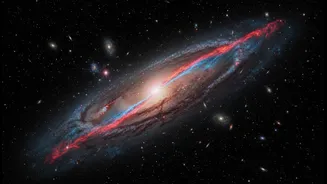
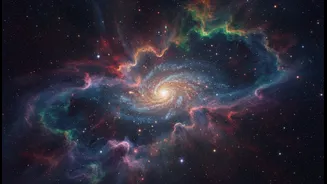
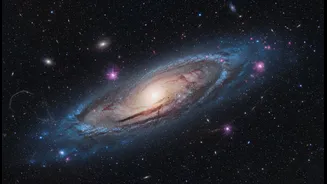
When NASA and its partners release a new image from the James Webb Space Telescope (JWST), the internet rightfully marvels. The latest, a portrait of Centaurus A released to mark the telescope’s fourth year of operations, is no exception. We see a whirlwind
of glowing dust, warped structures, and a core packed with millions of stars. It’s easy to get lost in the spectacle. Yet, the real magic isn’t just what the image shows, but what it allows scientists to understand. The key to appreciating it fully is to look beyond the initial 'wow' factor and ask what makes this particular galaxy, and this particular view, so scientifically valuable.
A Laboratory for Cosmic Chaos
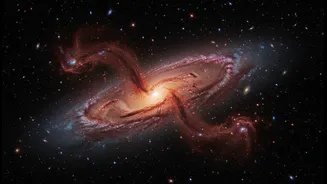
Centaurus A isn't just any galaxy; it's a cosmic laboratory located a relatively close 11-13 million light-years away. What makes it special is its violent history and hyperactive present. About two billion years ago, a large elliptical galaxy collided with and consumed a smaller spiral galaxy. The mangled remains of this merger are still visible today in its unusual structure and warped disk of gas and dust. At its heart lies a supermassive black hole that is actively feeding on surrounding material, launching powerful jets of energy that shape the entire system. Because it’s so close and so active, studying Centaurus A helps astronomers understand the fundamental processes that build and change galaxies across the universe.
Seeing the Unseen
So what’s new about this JWST image? The answer lies in the light. Centaurus A’s core is shrouded in thick dust, which acts like a cosmic fog, blocking the visible light that telescopes like Hubble rely on. JWST is designed to see in infrared light, which can pass through this dust. While previous infrared observatories like the Spitzer Space Telescope could see the galaxy's large structures, they lacked the power to see fine details. JWST changes the game. For the first time, what once looked like a hazy glow is now resolved into a dense landscape of countless individual stars. It’s also crucial to remember these images use 'false color.' Different colors are assigned to different infrared wavelengths to make invisible details scientifically meaningful and visually distinct. The image is a data visualization, not a literal photograph.
A Quick Guide to Cutting Through the Hype
When the next big space image drops, here’s how to focus on the real story. First, ask what’s fundamentally new. With Centaurus A, the breakthrough is resolving individual stars where none could be seen before. Second, listen for the questions, not just the answers. Real science reporting will highlight the new mysteries the image reveals, like an unusual S-shaped structure near the galaxy's center that scientists can't yet explain. Third, look for comparisons. The significance of a JWST image is often shown by placing it side-by-side with older images from Hubble or Spitzer, demonstrating the leap in capability. Finally, check the source. Official releases from NASA or the European Space Agency will ground the amazing visuals in concrete scientific goals.
The Real Breakthrough: Galactic Archaeology
The most profound advance this new image offers is the ability to perform what scientists call 'galactic archaeology.' By studying the individual stars now visible, astronomers can begin to piece together a detailed timeline of Centaurus A's history. They can differentiate between the older stars that existed before the galactic collision, the stars that were born during the violent merger, and the younger stars that formed in its aftermath. Each star is a fossil record, carrying information about the galaxy's evolution. This isn't just a snapshot; it's a history book written in starlight, and Webb is the first telescope powerful enough to read its pages with such clarity.