


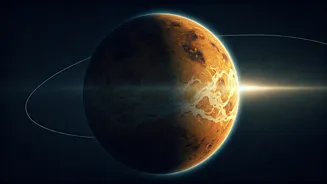


Defining a Day and a Year
Before we dive into Venus’s strange schedule, let's get our terms straight. A 'year' is simple: it’s the time it takes for a planet to complete one full orbit around its star. For Earth, that’s roughly 365 days. A 'day,' however, is a bit trickier. There
are two kinds. A 'sidereal day' is the time it takes for a planet to complete one full 360-degree rotation on its axis. A 'solar day' is the time it takes for the Sun to return to the same position in the sky—what we think of as the period from one sunrise to the next. On Earth, these two are very close (a sidereal day is 23 hours and 56 minutes, while a solar day is 24 hours), but on Venus, the difference is dramatic.
Venus By The Bizarre Numbers
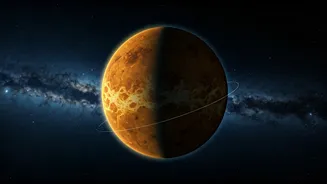
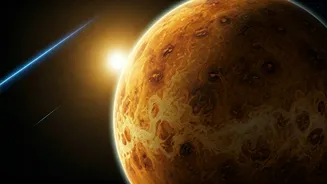
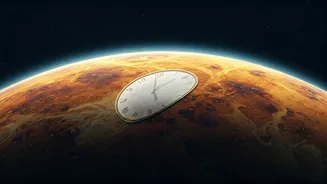
Here's where things get truly weird. A year on Venus—one trip around the Sun—takes about 225 Earth days. Now for its day. Venus takes a mind-boggling 243 Earth days to complete just one sidereal rotation. That’s right: its rotational period is longer than its orbital period. A single day of spinning on its axis lasts longer than its entire year. This is the core of Venus’s temporal oddity. Because of this, its solar day (sunrise to sunrise) is different. While the planet spins incredibly slowly, it’s also moving in its orbit around the Sun. The combination of these two motions means a solar day on Venus is about 117 Earth days long. So you’d have to wait nearly four Earth months for the next sunrise. Still bizarre, but it's the 243-day sidereal spin that truly breaks our Earthly intuition.
The Slow, Backward Spin
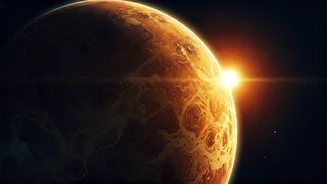
So, why does Venus spin so slowly? And to add another layer of strangeness, it spins backward. Nearly every other planet in our solar system, including Earth, rotates counter-clockwise on its axis (prograde motion). Venus rotates clockwise, a phenomenon known as retrograde rotation. If you could stand on its surface, you would see the Sun rise in the west and set in the east. Scientists have several theories for this backward spin. One leading idea is that early in its history, Venus was struck by a massive asteroid or planetesimal that was large enough to not just tilt its axis, but completely flip it upside down. Another theory suggests that the gravitational pull of the Sun on Venus's incredibly thick atmosphere, combined with friction between the atmosphere and the planet's core, gradually slowed and then reversed its rotation over billions of years.
A Thick Atmosphere's Crushing Grip
The theory of atmospheric influence is compelling. Venus’s atmosphere is a monster—over 90 times denser than Earth's and composed almost entirely of carbon dioxide. This creates a runaway greenhouse effect, making its surface hot enough to melt lead. This thick, heavy atmosphere is believed to act like a brake. It circulates much faster than the planet itself rotates, with super-hurricane-force winds whipping around the globe in just four Earth days. This powerful 'super-rotation' of the atmosphere is thought to exert a significant drag on the solid planet beneath it, slowing its spin to a crawl. The immense atmospheric pressure and the tidal forces from the Sun essentially locked Venus into its current, sluggish state. It’s a planetary-scale example of friction at work, sculpting the very rhythm of the world.
What This Means For the Planet
This extreme timing has profound consequences. With a solar day lasting 117 Earth days, one side of Venus bakes in unrelenting sunlight for months, while the other side is plunged into a prolonged night. You might expect the night side to cool down significantly, but Venus's thick atmosphere is brutally efficient at trapping and distributing heat. Those high-speed winds circulate the heat around the planet, so the night side remains almost as scorching as the day side. This means there’s virtually no temperature relief. Venus is a world of eternal, crushing heat, where the concepts of day and night offer little change from the hellish conditions on the surface, all dictated by a day that is longer than a year.