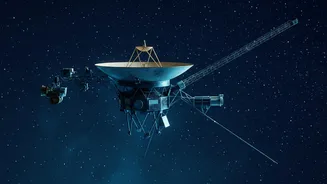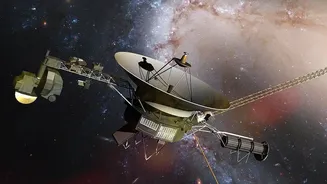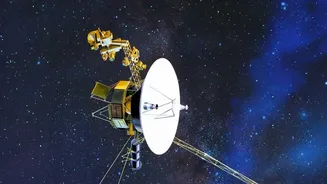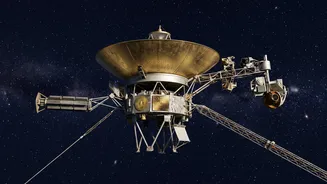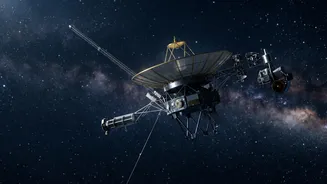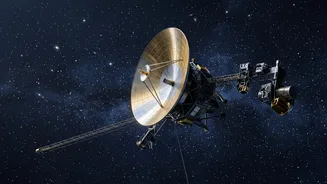




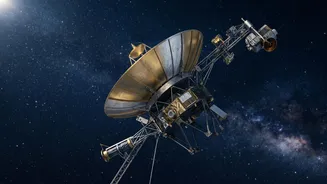
For two days in October, the loneliest machine ever built went silent. Nearly 26 billion kilometres from Earth, Voyager 1 stopped talking. The silence was deafening for its NASA team, but the story is far from over.
A Faint Voice Goes Quiet
On October 18 and 19, 2026, scheduled
communication attempts with Voyager 1 failed. The giant antennas of NASA's Deep Space Network listened for the faint radio signal from the edge of our solar system and heard nothing but static. For a 49-year-old probe travelling through interstellar space, silence is a terrifying prospect. The engineering team at the Jet Propulsion Laboratory (JPL) braced for the worst, knowing that any command sent to diagnose the problem would take almost a full day to arrive. But then, on October 20, before any troubleshooting commands could be sent, Voyager 1 called home on its own.
An Unexpected Recovery
The spacecraft’s signal reappeared, and communication has remained stable since. While engineers are still investigating the root cause of the blackout, they have pieced together what happened aboard the probe. Voyager 1’s onboard fault protection system, a pre-programmed set of autonomous responses, detected an issue. A group of the spacecraft’s thrusters, which are used for orientation, had gone offline. In response, the probe automatically switched to a backup set of thrusters and placed itself into a 'safe mode' to await further instructions. According to Kareem Badaruddin, the Voyager mission manager at JPL, this was the first time the spacecraft had performed this specific self-rescue maneuver, a reminder that at this late stage of the mission, engineers must be prepared for the unexpected.
Racing Against Fading Power
This recent scare highlights the central challenge of the Voyager mission today: power. Both Voyager 1 and its twin, Voyager 2, are powered by radioisotope thermoelectric generators (RTGs), which convert heat from decaying plutonium into electricity. After nearly half a century, that power source is fading. Every year, the spacecraft loses about four watts of power, forcing the mission team to make difficult decisions about which systems to shut down. To prolong the life of Voyager 1's scientific instruments, engineers recently performed a delicate power-saving maneuver nicknamed the 'Big Bang'. In September, they simultaneously switched off three devices and swapped them with three lower-power alternatives to conserve energy while keeping the spacecraft warm enough to operate. This move is expected to delay the next necessary instrument shutdown, which was previously anticipated for the summer of 2027.
A Light-Day Away
The drama unfolded just as Voyager 1 was approaching a monumental milestone. On November 18, 2026, the spacecraft will become the first humanly made object to be one light day away from Earth. This means it will be at a distance that takes light, and therefore its radio signals, a full 24 hours to travel. A round trip communication—a question from Earth and a response from Voyager—will take two days. This incredible distance, nearly 26 billion kilometres, underscores both the triumph of the mission and the immense difficulty of keeping it alive. Launched in 1977, Voyager 1 first studied Jupiter and Saturn before continuing its journey, crossing into interstellar space in 2012. It is now the only probe actively studying the region outside the protective bubble of our sun.