





What Makes a Meteorite Special?
Meteorites are fragments of asteroids, the Moon, or even Mars that survive a fiery journey through our atmosphere to land on Earth. They are time capsules, some older than the oldest rocks on our planet, carrying invaluable secrets about the formation
of our solar system. Scientists study them to understand the origins of planets and potentially life itself. Because they are delivered free of charge by nature, they are often called 'poor man's space probes'. In India, the Geological Survey of India (GSI) is the official custodian of all meteorites found in the country, maintaining a national repository in Kolkata.
First, How to Spot One
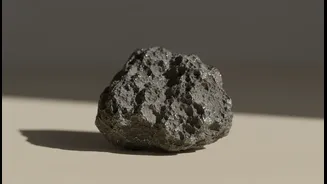
The vast majority of unusual rocks are not from space. But genuine meteorites have a few tell-tale characteristics. They are typically very dense and feel unusually heavy for their size due to their high iron content. This iron also means most meteorites will attract a magnet. A key feature is the 'fusion crust'—a thin, black, or dark brown rind that forms when the surface melts during atmospheric entry. This crust can sometimes look like an eggshell over a lighter interior. Some also have shallow, thumbprint-like indentations called regmaglypts, created by the hot air that sculpted them during their fall. However, they do not have bubbles or light-colored crystals like quartz.
The Golden Rule: Preserve, Don't 'Perfect'
The impulse to scrub a dirty rock is understandable, but with a suspected meteorite, it's a destructive mistake. Every action—scraping, washing, polishing, or breaking—can contaminate the specimen and destroy priceless scientific data. The oils and microbes from your bare hands are enough to begin degrading the surface, promoting rust and contaminating it for future analysis. That dark, dull fusion crust you might be tempted to polish away is one of the most important features, telling the story of its violent and fiery descent to Earth. Removing it is like tearing the cover off a priceless ancient book. Even using a magnet can be problematic for certain rare types destined for specific scientific tests.
Why 'Cleaning' Destroys Value
Scrubbing with water, household cleaners, or even wire brushes can introduce terrestrial materials and chemicals into the rock's porous structure, permanently altering its composition. This contamination makes it impossible for scientists to get an accurate reading of its original makeup. Beyond the scientific loss, this damage also craters its financial value. Collectors and institutions prize meteorites for their pristine condition and provenance. A 'cleaned' or damaged specimen is worth significantly less, if anything at all, compared to a carefully preserved one. Some rare meteorites from the Moon or Mars can fetch prices higher than gold, but only if they are handled correctly from the moment of discovery.
The Peril of the Hammer
Breaking the rock open to see what’s inside is perhaps the most damaging action of all. A meteorite is studied as a whole object. Breaking it destroys the context of its structure and can shatter important internal features like chondrules—tiny, ancient spherical grains that are among the first solids to form in the solar system. Scientists use specialised saws and techniques in clean-room laboratories to cut meteorites in a way that minimizes contamination and preserves slices for multiple types of analysis. A hammer blow in the field simply reduces a unique cosmic artifact into a pile of contaminated fragments, erasing both its scientific and monetary worth in an instant.
What to Do Instead: A Simple Guide
If you believe you've found a meteorite, you can become a crucial part of a scientific discovery by following a few simple steps. First, don't touch it with your bare hands. Photograph it exactly where you found it, including something for scale like a coin. Note the precise location, using your phone’s GPS if possible. To collect it, use clean aluminum foil or a clean plastic bag to pick it up, preventing direct contact. Keep it dry and store it in a sealed bag away from moisture. Once secured, the next step is to contact the experts. In India, the appropriate authority is the Geological Survey of India (GSI) or the geology department of a local university. They are equipped to verify your find and ensure it's preserved for science.