



A Landmark Discovery
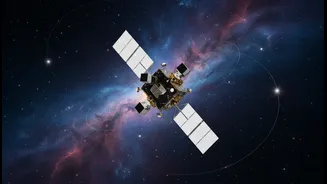
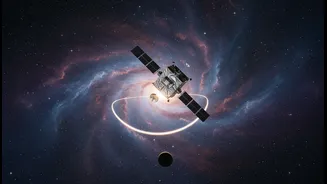
Scientists have announced a significant first for NASA's Transiting Exoplanet Survey Satellite, or TESS. The spacecraft has successfully identified its first planet using a method called gravitational microlensing. The newly confirmed world, named Gaia23bra
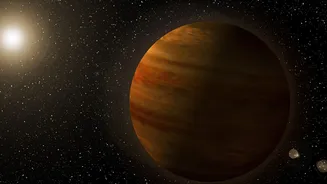
b, is a gas giant about 1.6 times the mass of Jupiter. It orbits an orange dwarf star approximately 40,000 light-years from Earth. This is a remarkable achievement for a satellite that was not originally designed for this kind of detection. As researchers combed through archival data, they found that TESS had serendipitously captured the tell-tale signs of this planet, confirming an initial hint picked up by the European Space Agency's Gaia telescope in 2023.
TESS’s Usual Planet-Hunting Method
To appreciate why this new discovery is so important, it helps to understand how TESS usually finds planets. Its primary technique is the transit method. TESS’s four powerful cameras stare at vast patches of the sky, monitoring hundreds of thousands of stars for tiny, periodic dips in their brightness. These dips often indicate that a planet is passing in front of its star from our point of view, blocking a small fraction of its light. This method is incredibly effective and has been used to find thousands of exoplanets. However, it works best for finding large planets that orbit very close to their stars, as these produce the most noticeable and frequent transits. The transit method has a typical search radius of about 150 light-years from Earth.
A Trick of Light and Gravity
Gravitational microlensing is a completely different and more complex phenomenon, first predicted by Albert Einstein. It occurs when a star with a planet passes almost directly in front of a much more distant, unrelated star. The gravity of the foreground star acts like a magnifying glass, bending and amplifying the light from the background star, causing it to brighten temporarily. If the foreground star has a planet, its own gravity adds a second, much smaller 'blip' or spike to the brightening event. This planetary signal is what astronomers hunt for. The effect is rare, requiring a perfect alignment of three objects in space: the distant source star, the closer lens star with its planet, and the observer on Earth.
Why This Discovery Changes the Game
This discovery of Gaia23bra b is a game-changer because it proves TESS can do something it was never expected to do. It expands the satellite's capabilities far beyond its original design. While the transit method is excellent for finding close-in planets, microlensing is uniquely suited to finding planets at much greater distances from their stars, similar to the orbits of Jupiter and Saturn in our own solar system. It can also detect planets that are significantly farther away from Earth. Gaia23bra b, at 40,000 light-years, is vastly beyond TESS's typical reach. This finding demonstrates that a treasure trove of these more distant, colder planets may be hiding in TESS's existing data, just waiting to be found.
A New Toolkit for Finding Other Earths
The two methods, transit and microlensing, are highly complementary. One finds large, hot worlds close to their stars, while the other is sensitive to smaller, colder planets in wider orbits—the kind that might be more like Earth. By successfully using both techniques, TESS is now a more versatile tool in the quest to understand planetary systems across our galaxy. This success serves as an exciting preview of what's to come with future missions like NASA's Nancy Grace Roman Space Telescope, which will use microlensing as one of its primary methods to discover thousands of new worlds. This breakthrough validates the power of combining data from different telescopes and paves the way for a more complete census of the planets in our Milky Way.