

The Cosmic Middle Child
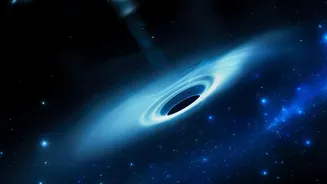
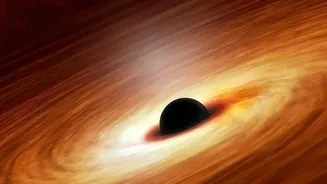
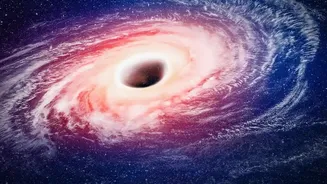
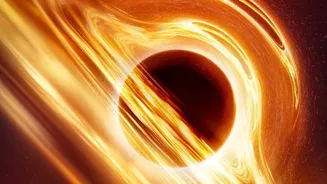
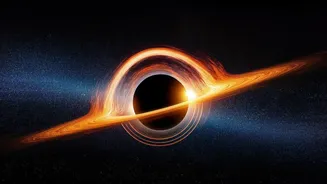
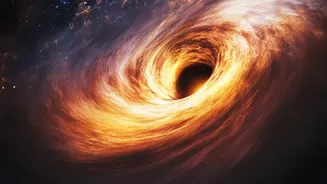
Black holes come in two well-known sizes: stellar-mass, which are up to a few dozen times the mass of our Sun and form from the collapse of giant stars, and supermassive, which are millions or billions of times our Sun's mass and anchor the centers of galaxies.
For years, astronomers have hunted for the 'missing link' between them: intermediate-mass black holes (IMBHs). These elusive objects, ranging from hundreds to hundreds of thousands of solar masses, have been incredibly difficult to confirm. They are too small to be the obvious centres of large galaxies, but too large to be formed from a single star's death. Finding them is crucial because they are the leading candidates for the 'seeds' that grow into the supermassive giants we see today. The mystery has been whether these IMBHs even existed in significant numbers, and if so, how we could ever prove it.
Listening to Ripples in Spacetime
The key to finding these hidden giants turned out not to be seeing, but listening. When two massive objects like black holes spiral into each other and merge, they send out powerful ripples in the very fabric of spacetime called gravitational waves. These waves, predicted by Albert Einstein a century ago, travel across the universe at the speed of light. On Earth, incredibly sensitive observatories like the Laser Interferometer Gravitational-Wave Observatory (LIGO) in the United States, Virgo in Italy, and KAGRA in Japan, can detect these faint tremors. By analysing the precise shape and frequency of a gravitational wave signal, scientists can determine the masses and spins of the objects that created it. After a series of recent upgrades, these detectors are now more sensitive than ever, capable of spotting multiple collisions every week.
A Chorus of Collisions
Recent analyses of data from the LIGO-Virgo-KAGRA (LVK) collaboration have provided the strongest evidence yet for a population of merging IMBHs. The latest catalog of gravitational wave events, GWTC-5, includes 161 new detections, bringing the total to 390. Among them are tell-tale signs of what scientists call hierarchical mergers. This is the idea that black holes can merge not just once, but multiple times. A key piece of evidence comes from the spin of the black holes. A black hole formed from a star tends to have low spin, but when two black holes merge, the resulting, larger black hole spins very fast. Scientists have now identified a distinct population of heavier, rapidly spinning black holes, which strongly suggests they are 'second-generation' objects born from previous mergers. This provides the smoking-gun evidence that black holes are indeed building up in size through repeated collisions.
The Supermassive Growth Plan
This confirmation of hierarchical mergers provides a clear and powerful pathway for how supermassive black holes form. The theory, known as hierarchical assembly, suggests that in the crowded environments of dense star clusters or near galactic centers, stellar-mass black holes collide to form IMBHs. These newly formed IMBHs, being more massive, sink toward the center of the cluster, where they are more likely to find and merge with other black holes, growing larger with each collision. Over cosmic timescales, this process can repeat, building black holes up from tens of solar masses to hundreds, then thousands, and eventually millions. The recent detections fill in a critical gap in this model, showing that the process doesn't just happen in theory, but is actively occurring across the universe. While many questions remain, the new data transforms our understanding from a hypothesis into an observationally supported framework.