

The Spectacular Death of a Sun-Like Star
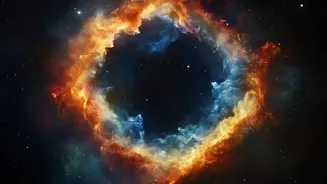
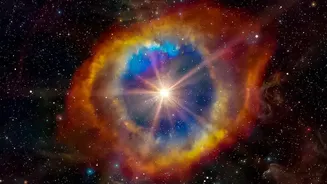
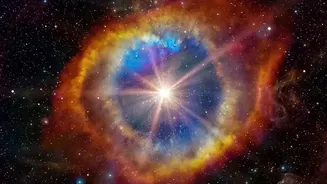
First things first: the Helix Nebula is not an eye, but the beautiful remnant of a dying star. Located about 650 light-years away, it’s what astronomers call a planetary nebula—a slightly confusing name, as it has nothing to do with planets. This is the final,
glorious act for a star that was once similar to our own Sun. After billions of years of burning through its fuel, the star could no longer support its own weight. Its outer layers of gas were puffed away into space, while its core collapsed into an incredibly hot, dense object called a white dwarf. That tiny but powerful white dwarf sits right in the center, like a pupil, blasting out intense ultraviolet radiation that causes the expelled gas to glow brilliantly. The entire structure is enormous, spanning about 2.5 light-years from end to end.
It's All About Perspective
The main reason the Helix Nebula looks like an eye is a cosmic trick of perspective. You might imagine it as a perfect sphere of gas, but its structure is more complex. Scientists believe it's actually shaped more like a cylinder or a prolate spheroid—think of a football or a donut that we happen to be viewing from one end. From our vantage point on Earth, we are looking straight down the barrel of this gaseous tunnel. The brightly lit rim of the tunnel forms the 'iris,' while the darker, emptier space in the middle gives the impression of a pupil. The faint red glow that often forms the 'eyelid' is made of cooler, more distant gas. If we could fly a spaceship around to the side of the nebula, it would look completely different—more like a tube or a barrel of glowing gas, losing its familiar eye-like shape entirely.
Why Webb's View Is a Game-Changer
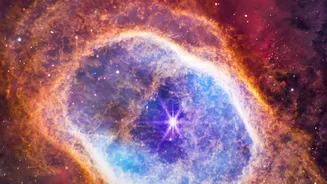
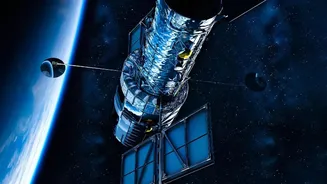
Previous telescopes like Hubble have given us stunning pictures of the Helix, but the James Webb Space Telescope sees the universe in a different light—literally. Webb is designed to detect infrared light, which is invisible to the human eye. This allows it to peer through the clouds of gas and dust that can obscure details in visible light, revealing the intricate structures within. The colors you see in Webb's images are 'representative color,' where scientists assign visible colors like red, green, and blue to different infrared wavelengths. Typically, longer wavelengths are colored red and shorter ones blue. This technique doesn't just make the images beautiful; it highlights different temperatures, densities, and chemical compositions, giving scientists a wealth of new information. For the Helix, Webb’s new image provides an unprecedentedly sharp view of the delicate, filamentary structures of the gas.
A Closer Look at the 'Cometary Knots'
One of the most fascinating features of the Helix Nebula, brought into sharp focus by Webb, is its thousands of “cometary knots.” Despite the name, these aren't actual comets. They are dense, tadpole-shaped clumps of gas that form within the nebula, each roughly the size of our entire solar system. Their existence has long puzzled astronomers, and Webb’s incredibly high-resolution infrared image gives us our best look yet at these mysterious structures. The image reveals thousands of these knots pointing away from the central star, like streamers caught in a celestial wind. They are created as the hotter, faster wind from the dying star slams into the cooler, slower-moving gas that was shed earlier, creating a complex and turbulent environment that is still not fully understood.
A Preview of Our Solar System's Fate
Looking at the Helix Nebula is like looking into our own solar system's distant future. In about five billion years, our Sun will run out of its primary nuclear fuel and will begin to die in a similar fashion. It will swell into a red giant, shedding its outer layers to create its own planetary nebula. Earth, as we know it, will almost certainly be destroyed in the process, but from a great distance, our Sun’s final act will create a beautiful, glowing monument in space. Studying the intricate processes at play in the Helix Nebula, from its overall shape to its mysterious cometary knots, helps astronomers understand the life cycle of stars and the way they enrich the galaxy with heavier elements that will one day form new stars and planets.