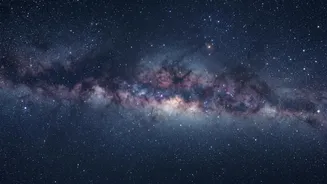

For decades, we’ve understood the universe to be about 13.8 billion years old. Now, new research from Canadian scientists challenges that fundamental number, suggesting our cosmos might actually be 26.7 billion years old.
Our Current Cosmic Clock
The accepted age of the universe
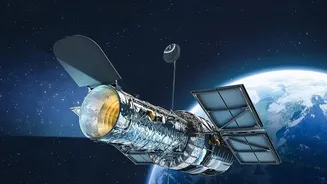
is a cornerstone of the Standard Model of Cosmology, known as the Lambda-CDM model. This model has been remarkably successful, explaining everything from the faint afterglow of the Big Bang, called the Cosmic Microwave Background, to the large-scale structure of galaxies we see today. Scientists arrive at the 13.8-billion-year figure by measuring the universe's expansion rate and tracing it back to a singular starting point. This expansion causes light from distant galaxies to stretch into redder wavelengths, a phenomenon called redshift, which acts like a cosmic measuring stick for distance and time. But in recent years, this tidy picture has developed a few cracks. The most significant challenge has come from the James Webb Space Telescope (JWST).
The 'Impossible' Galaxy Problem
The JWST has been spotting galaxies in the very early universe that are surprisingly mature and massive. According to the 13.8-billion-year timeline, these galaxies, seen just a few hundred million years after the Big Bang, should be small and primitive. Instead, they appear to have structures and mass that would typically take billions of years to develop. This conundrum, dubbed the 'impossible early galaxy problem', has left astronomers searching for an explanation. One solution is that our understanding of galaxy formation is wrong. Another, more radical possibility, is that the cosmic clock itself is off.
A Radical New Timeline
This is where a new model from Rajendra Gupta, a professor at the University of Ottawa, comes in. His work proposes a universe that is 26.7 billion years old, nearly double the current estimate. An older universe would elegantly solve the 'impossible galaxy' problem by providing these ancient structures with several billion extra years to form and evolve. Under the standard model, a galaxy seen at 'cosmic dawn' would have formed when the universe was about 300 million years old. In Gupta's model, the universe would have already been around 4.6 billion years old at that same point, giving galaxies plenty of time to mature.
Rethinking Redshift and Reality
To achieve this older age, Gupta's model, called CCC+TL, makes two significant changes to standard cosmology. First, it revives a decades-old idea called 'tired light', originally proposed by Fritz Zwicky in 1929. This theory suggests that light loses energy as it travels across vast cosmic distances, which contributes to its redshift. Gupta's model doesn't replace expansion with tired light, but rather combines them, suggesting redshift is a hybrid phenomenon. The second element involves 'covarying coupling constants', suggesting that the fundamental forces of nature might change over time. Together, these ideas paint a picture of the cosmos that doesn't require the existence of dark matter or dark energy, two mysterious components that make up about 95% of the universe in the standard model but have never been directly detected.
The Debate Continues
Gupta and his collaborator, Nikolaos Samaras, have tested their CCC+TL model against several observations, reporting that it aligns with data on galaxy rotation and the abundance of elements created after the Big Bang, all without needing dark matter. However, the theory remains far from mainstream acceptance. The 'tired light' hypothesis has historically been dismissed because it predicted that distant objects should appear blurred, which they don't. Proponents of the standard model point to its overwhelming success in explaining a vast range of cosmic observations. Gupta's model is a provocative proposal that addresses some genuine puzzles in cosmology, but it represents a fundamental shift in our understanding of physics and will require much more evidence and scrutiny before it can seriously challenge the established timeline of our universe.