

The Sun's Inevitable Transformation
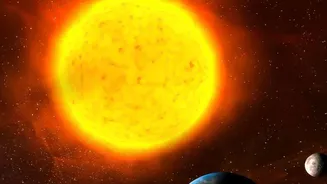
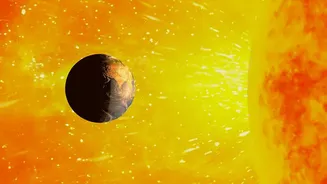
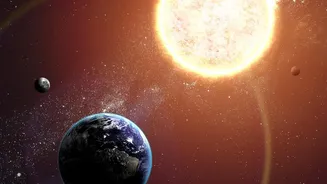
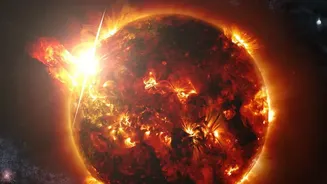
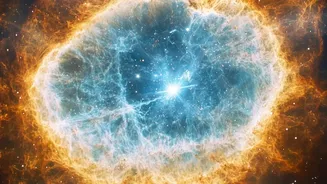
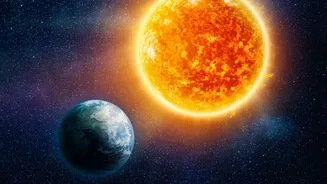
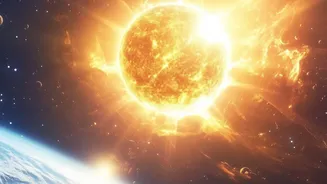
In about five billion years, the Sun will exhaust the hydrogen fuel in its core. This will trigger a catastrophic transformation, causing it to swell into a red giant. Its outer layers will expand dramatically, potentially reaching a size more than 200
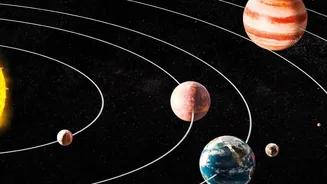
times its current diameter. This bloated version of our star will be so large that it will engulf the inner planets. Mercury and Venus are certain to be consumed. Earth's fate hangs in the balance; while the Sun's weakened gravity may allow our planet's orbit to drift outward, the star's expanding shell could still swallow it whole. Even if Earth escapes being engulfed, the intense heat will have long since boiled away its oceans and atmosphere, rendering it a lifeless, scorched rock.
The Giants' Gravitational Dance
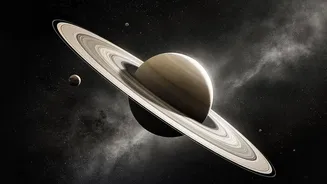
Further out, the gas giants—Jupiter and Saturn—are the undisputed kings. Their immense gravity has shaped the solar system since its formation. The complex orbital relationship between these two planets, a gravitational 'dance,' has long been a stabilizing force. For much of the solar system's history, their rhythmic pull has helped keep the orbits of other planets in check and even protected the inner system from a higher frequency of catastrophic impacts. However, as the Sun begins its death throes, this delicate balance will be shattered, and the giants will become agents of chaos.
A Chaotic End for the Outer Planets
As the Sun becomes a red giant and later collapses into a white dwarf, it will shed nearly half its mass. This mass loss won't be a smooth, gentle process. Recent studies suggest it will happen in violent, uneven bursts. These powerful ejections will act like 'kicks,' sending gravitational ripples throughout the solar system and nudging the giant planets into increasingly unstable orbits. Previous models suggested the outer planets might remain stable for hundreds of billions of years, but this new understanding of the Sun's turbulent end dramatically shortens that timeline. The stability that once defined our solar system will unravel.
Planetary Ejection and a New System
With the Sun's gravitational grip loosened and the chaotic nudges from its mass loss, the powerful influence of Jupiter and Saturn will take over. Their interactions could destabilize the orbits of the ice giants, Uranus and Neptune, to such an extent that they could be ejected from the solar system entirely, sent wandering into interstellar space. Some simulations show that in about 40% of cases, this disruption will start even before the Sun has fully become a white dwarf. The solar system that remains will be a shadow of its former self, a vastly different and emptier place.
Life Around a White Dwarf
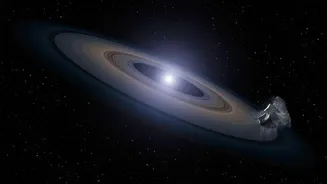
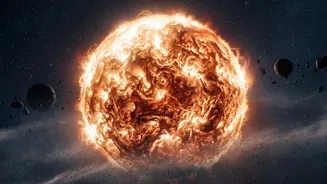
After the Sun sheds its outer layers, its hot, dense core will remain as a white dwarf—a stellar remnant about the size of Earth. This 'dead' star will no longer produce energy through fusion, but it will continue to shine with leftover heat for billions of years before eventually fading. Any planets that manage to survive the red giant phase and the subsequent chaos will find themselves orbiting this dim cinder. Observations of other white dwarf systems show that they are often surrounded by the dusty debris of shattered planets, asteroids, and moons, a testament to the violent end that many planetary systems face.