

A Glimmer in the Outer Dark
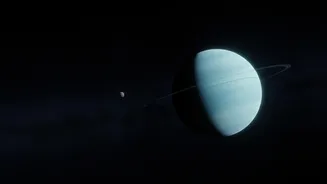
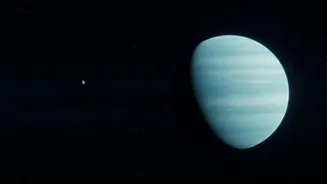
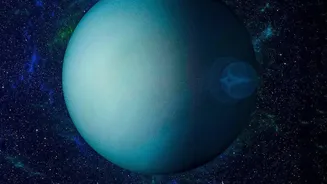
The latest addition to Uranus’s family of satellites, provisionally named S/2023 U1, is a cosmic speck. Measuring only about eight kilometres across, it is likely the smallest of the planet’s 28 known moons. It was first spotted on November 4, 2023, by
astronomer Scott S. Sheppard of the Carnegie Institution for Science. He was using the powerful 6.5-metre Magellan telescope in Chile, but even with such an instrument, finding this moon was an immense challenge. It is one of the faintest moons ever detected around an ice giant planet from a ground-based observatory, a testament to the technological prowess and patience required for modern astronomical discovery.
The 'Shift-and-Add' Technique
You can't just point a telescope and see an object this faint and small directly. The discovery relied on a clever data processing method known as the "shift-and-add" technique. Sheppard took a series of long-exposure images over several hours on the night of the discovery. In any single image, the moon would be lost in the noise. To make it visible, the images were digitally layered. The key is that the software shifts each image to align with the predicted movement of Uranus across the sky. When these aligned images are stacked, the faint light of the moon adds up, revealing it as a single, stationary point. Meanwhile, distant stars and galaxies, which are not moving with Uranus, are smeared into long trails. This special processing is what allowed the moon’s faint signal to emerge from the darkness.
A Two-Year Game of Cosmic Tag
Finding a dot of light is one thing; proving it’s a moon is another. An object could be a passing asteroid or comet. To confirm that S/2023 U1 was gravitationally bound to Uranus, researchers needed to map its orbit. This required a long-term game of cosmic tag. After the initial detection in November 2023 and follow-up observations a month later, Sheppard collaborated with orbit specialists from NASA’s Jet Propulsion Laboratory to calculate a probable path for the object. With a predicted orbit in hand, he could go back and search for the moon in older data. He successfully located it in images he had taken more than two years earlier, in late 2021, using both the Magellan telescope and the Subaru telescope in Hawaii. This two-year observation arc was crucial to confirming its long, 680-day journey around Uranus.
The Challenges of a Distant Orbit
Studying the movement of S/2023 U1 is complicated by its sheer distance and leisurely path. The moon orbits Uranus at an average distance of nearly 8 million kilometres and takes almost two Earth years to complete a single revolution. Its orbit is also eccentric and highly inclined, meaning its path is an elongated oval tilted relative to the planet. These distant, irregular moons are only loosely held by Uranus's gravity, making their orbits susceptible to perturbations from the Sun and other planets. This means its path isn't perfectly predictable and requires continuous observation and refinement. Tracking such a slow-moving, faint object over multiple years is a painstaking process that tests the limits of both technology and astronomers' persistence.
Why We Hunt for Tiny Moons
The effort to find and track these tiny, remote worlds is more than just an exercise in cosmic accounting. These irregular moons are thought to be captured objects, relics from the solar system's chaotic youth that were pulled into orbit by the ice giant's gravity billions of years ago. The orbit of S/2023 U1 is similar to two other Uranian moons, Caliban and Stephano. This suggests they may all be fragments of a larger parent body that was shattered by a collision with a comet or asteroid long ago. By studying these orbital families, scientists can piece together a history of the outer solar system, refining their models of how planets formed and evolved, and revealing the violent events that shaped the planetary systems we see today.