




The Challenge of Size and Speed
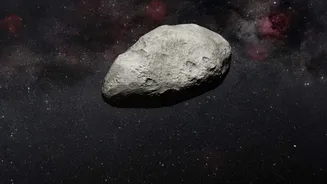
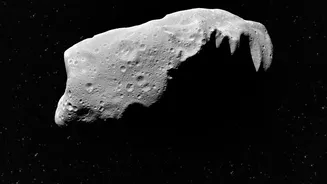
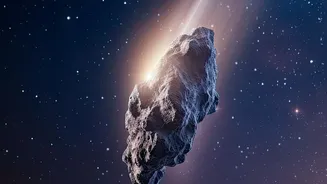
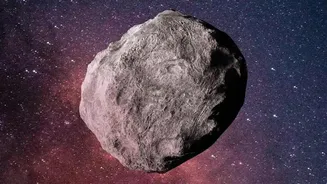
The simplest reason for late detection is that many asteroids are small and fast. The vastness of space is almost impossible to comprehend, and searching for relatively tiny objects within it is a monumental task. Objects smaller than about 25 meters
in diameter often burn up completely in our atmosphere, posing little threat. Because of this, global planetary defense efforts, like those coordinated by NASA, prioritize finding asteroids larger than 140 meters, which could cause significant regional damage. Smaller rocks, even those the size of a car or a house, reflect very little sunlight, making them incredibly faint and difficult for even powerful telescopes to spot until they are very close. Their high velocity means the window of opportunity for discovery is often fleeting.
The Sun: A Cosmic Blind Spot
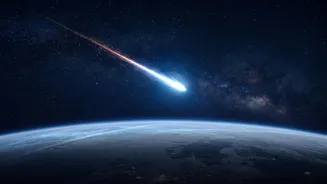
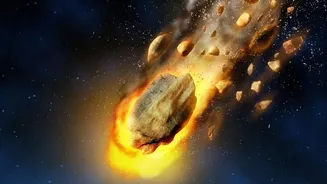
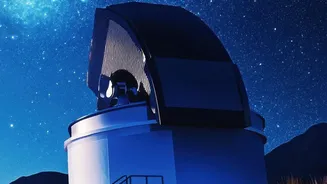
One of the biggest challenges for ground-based telescopes is a massive blind spot: the sun. Telescopes on Earth survey the night sky, looking for the faint, reflected light of distant objects. An asteroid approaching Earth from the direction of the sun is completely lost in its overwhelming glare. This was exactly the case with the Chelyabinsk meteor in 2013, an object roughly 20 meters wide that exploded over Russia with no prior warning. It arrived with the morning sun, making it invisible to observatories. Discovering these "twilight asteroids" requires specific survey strategies, such as scanning the sky just before sunrise or after sunset, but it remains a significant gap in our detection capabilities.
Tricky Orbits and Earth's Gaze
An asteroid's path through the solar system is another crucial factor. Our network of survey telescopes is powerful but doesn't cover the entire sky all the time. An asteroid might have an orbit that keeps it far from Earth for centuries, only to have its path tweaked by the gravity of another planet. Some have highly elliptical or unusual orbits that don't bring them into our line of sight until the final approach. Current survey systems rely on taking multiple images of the sky and using software to detect objects that have moved against the background stars. If an asteroid's approach is steep or from a direction not being actively monitored, it can easily be missed.
A Race Against Time
When a small asteroid is detected just hours before impact, it triggers a rapid response. Astronomers and organizations like NASA's Planetary Defense Coordination Office and the European Space Agency quickly share data to refine the object's trajectory and predict its impact zone. While there’s no time to launch a deflection mission, as would be needed for a larger, more distant threat, these last-minute detections are invaluable. They serve as real-world drills for our planetary defense systems, allowing scientists to test their tracking models and communication networks. A recent example on September 6, 2026, saw a small asteroid designated CERNQ52 tracked for hours before it safely disintegrated over the Indian Ocean, marking only the 13th time an impactor had been predicted in advance.
The Future of Finding Asteroids
Scientists are actively working to close these detection gaps. The Vera C. Rubin Observatory, which has already discovered thousands of new asteroids in preliminary tests, is expected to revolutionize our knowledge by repeatedly scanning the entire southern sky with unprecedented sensitivity. This will help catalog millions of asteroids and improve our statistical understanding of the near-Earth population. Furthermore, space-based telescopes represent the next frontier. Missions like NASA's NEO Surveyor will be positioned in space to hunt for asteroids in infrared, allowing them to spot objects regardless of their reflectivity and, crucially, to look in the direction of the sun, finally illuminating our biggest blind spot.