





The Fiery Problem of Hitting the Brakes
One of the greatest challenges in spaceflight isn't leaving Earth, but coming back. When a spacecraft enters a planet's atmosphere at hypersonic speeds, it converts immense kinetic energy into heat, reaching temperatures that can vaporise metal. For decades,
the solution has been rigid, solid heat shields. These work well, but they have a fundamental limitation: their size is constrained by the rocket's launch fairing, the nose cone that protects the payload. This size limit directly restricts the mass of the payload they can protect, creating a major bottleneck for ambitious missions, especially to planets with thin atmospheres like Mars. A larger shield would create more drag, slowing the vehicle more effectively at higher, safer altitudes, but you can't launch what you can't fit in the rocket.
An Inflating Solution to a Massive Challenge
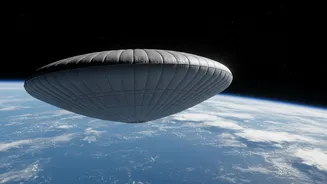
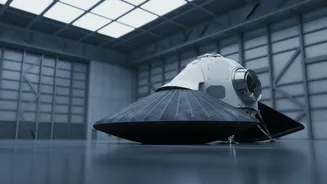
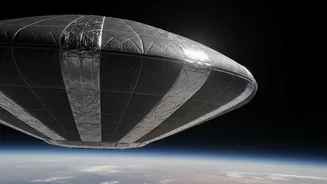
Enter the Hypersonic Inflatable Aerodynamic Decelerator (HIAD), a technology NASA has been developing for over a decade. The concept is as elegant as it is effective: a heat shield that launches in a tightly packed, compact state and inflates to a much larger size just before atmospheric entry. This innovation neatly bypasses the size constraints of launch rockets. NASA's successful Low-Earth Orbit Flight Test of an Inflatable Decelerator (LOFTID) mission provided a powerful demonstration of this concept. The LOFTID aeroshell, packed for launch, inflated to a diameter of six meters (about 20 feet) in orbit before successfully re-entering Earth's atmosphere, surviving the intense heat and pressure.
How an Inflatable Shield Survives Re-entry
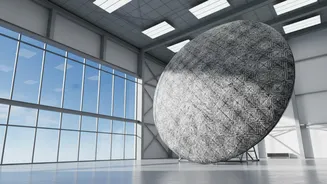
An inflatable heat shield may sound delicate, but it's a marvel of material science. The inflatable structure itself is composed of stacked rings, or tori, woven from synthetic polymers that are incredibly strong and temperature-resistant. This structure is protected by a flexible thermal protection system. The outermost layer is a woven ceramic fabric, often made from silicon carbide fibres, capable of withstanding the extreme temperatures of re-entry. Beneath this are layers of high-tech insulation designed to keep the intense heat from reaching the inflatable structure and the payload it protects. During re-entry, the large surface area of the inflated shield acts like a giant brake, creating significant aerodynamic drag that slows the vehicle from over 18,000 mph to manageable speeds much higher in the atmosphere, reducing peak heating.
Unlocking the Future of Planetary Exploration
The success of inflatable heat shields is a game-changer for space exploration. By allowing for larger aeroshells, this technology enables the landing of heavier and more substantial payloads. For Mars, this means the possibility of landing advanced robotic rovers, larger habitats, and eventually, the life-support systems needed for human missions. The greater drag also allows for landings at higher-altitude sites on Mars, which are currently inaccessible with rigid heat shields because the thin atmosphere doesn't provide enough braking force in time. This opens up new, scientifically valuable regions for exploration. The technology isn't limited to Mars; it has potential applications for missions to Venus, Saturn's moon Titan, and for returning large cargo or reusable rocket stages to Earth.