




A Trick of the Mind, Not the Sky
First, let's be clear: the Moon's size doesn't change as it crosses the sky. If you were to measure its diameter with a camera or even by holding a coin at arm's length, you would find it covers the same amount of space whether it's rising, setting, or directly
overhead. In fact, due to the geometry of your position on Earth, the Moon is technically thousands of kilometres farther away when it's on the horizon compared to when it's at its zenith, meaning it should appear slightly smaller, not larger. The massive size difference we perceive is a powerful and ancient optical illusion, one that has puzzled thinkers from Aristotle to modern-day scientists. It’s not an atmospheric effect like a mirage or a magnifying lens; the whole captivating experience happens entirely inside your head.
Your Brain's Flattened Sky Dome
The leading explanation for the Moon illusion is known as the Apparent Distance Hypothesis, which hinges on how our brains perceive the sky. We don’t see the sky as a perfect hemisphere stretching from horizon to horizon. Instead, our brain interprets it as a much flatter dome, like an inverted bowl. Think about clouds: the ones directly overhead might be only a few kilometres up, while clouds near the horizon could be hundreds of kilometres away. This experience teaches our brain that things near the horizon are generally much farther away than things that are high in the sky. When the Moon appears in this 'distant' part of our mental sky map—the horizon—our brain assumes it must be very far away.
The Ponzo Illusion on a Cosmic Scale
This perceived distance directly affects perceived size, a phenomenon explained by the Ponzo Illusion. Imagine two identical lines drawn on a set of railroad tracks that are converging toward the horizon. The line drawn where the tracks are closer together appears longer than the one drawn where the tracks are farther apart, even though they are the same length. Your brain, using the converging tracks as a distance cue, interprets the 'farther' line as being physically larger to produce an image of that size. The Moon illusion works the same way. The Moon always creates the same size image on our retinas. When it's high in the empty sky (like the 'near' line on the tracks), our brain sees it for what it is. But when it's on the horizon, surrounded by depth cues suggesting great distance, our brain says, 'If that object is so far away and still looks this big, it must be enormous!' and scales up its perceived size accordingly.
The Importance of Scenery
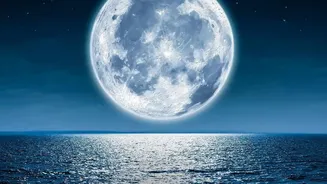
The presence of foreground objects is a crucial part of the illusion for most people. When the Moon is low in the sky, we see it in context with trees, buildings, and mountains. Our brains know these objects are far away and have a sense of their scale. The Moon, appearing behind them, is understood to be even farther. This uninterrupted sequence of objects creates a powerful sense of depth that is completely absent when the Moon is high in a vast, empty expanse of sky. Take away the horizon and the landscape, and the illusion often vanishes. This is one reason why the illusion can feel less potent on a boat at sea or in a flat, featureless desert. The scenery provides the reference points our brain needs to trick itself.