


A Galaxy Shaped by Collision
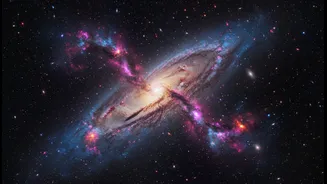
Centaurus A is not your typical spiral or elliptical galaxy. Its appearance, marked by a bright central bulge sliced by a dark, wide band of dust, has long fascinated astronomers. This unusual structure is the result of a violent past; scientists believe
that about two billion years ago, Centaurus A collided with and consumed a smaller galaxy. This cosmic merger left behind a warped disk of gas and dust that still scars its center, making it a perfect natural laboratory for studying the dramatic events that shape galaxies across the universe. Its relative proximity and intense activity, including a supermassive black hole at its core, make it a prime target for observation.
Webb's Unprecedented New View
To mark its fourth year of science operations, NASA has released breathtaking new images of Centaurus A captured by the James Webb Space Telescope (JWST). Where previous observatories like Hubble were blocked by cosmic dust and older infrared telescopes like Spitzer lacked the necessary sharpness, Webb has pierced through the haze. Using its powerful Near-Infrared Camera (NIRCam) and Mid-Infrared Instrument (MIRI), the telescope has provided a view of unprecedented detail. What once looked like a hazy glow is now resolved into a stunning landscape of millions of individual stars, intricate filaments of glowing gas, and complex dust structures.
The Technology That Pierces the Veil
The secret to this new view lies in the JWST's specialized technology. The telescope is designed to see the universe in infrared light, which can pass through the dense clouds of dust that obscure visible light. The combination of its MIRI and NIRCam instruments allows it to capture different aspects of the galaxy. NIRCam is able to resolve the light from millions of individual stars, transforming a grainy patch of light into a detailed field of distinct points. Meanwhile, MIRI highlights the warm dust itself, revealing a bizarre, glowing parallelogram shape and a mysterious S-shaped structure near the core that have intrigued astronomers. This level of detail, resolving structures smaller than the distance light travels in a day, was previously impossible.
Unlocking a Galactic Timeline
This fresh cosmic close-up is more than just a pretty picture; it is a treasure trove of scientific data. By being able to distinguish individual stars within the galaxy's turbulent center, astronomers can now study different generations of stars that formed at various points in its history. This allows them to create a more precise timeline of the galaxy's evolution, pinpointing when the ancient collision triggered frantic bursts of new star birth. Furthermore, Webb's instruments can measure how gas moves within the galaxy. Early findings show warm hydrogen gas rotating near the central black hole while other gas is being rapidly pushed outward, providing new clues about how these powerful objects can both create and destroy.
The Black Hole's Double-Edged Sword
At the heart of Centaurus A lies a supermassive black hole with the mass of 55 million suns, actively feeding on the material around it. As it consumes gas and dust, it unleashes enormous jets of energy that ripple through the galaxy. The new Webb data reveals a complex relationship: the black hole's activity appears to be triggering star formation in some areas by compressing gas, while simultaneously choking it off elsewhere by violently blowing away the necessary raw materials. Understanding this dual role is critical for building a complete picture of how black holes and their host galaxies evolve together. The new images help scientists better understand the powerful jets, which appear brighter at their edges, a feature that challenges some theoretical models.