




A Cosmic Size Problem
Imagine looking at a picture of a newborn baby that stands six feet tall. That’s the kind of shock astronomers are experiencing right now. Using the powerful gaze of the James Webb Space Telescope (JWST), scientists have spotted black holes in the very
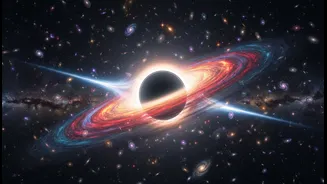
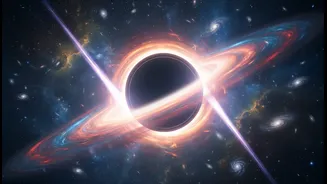
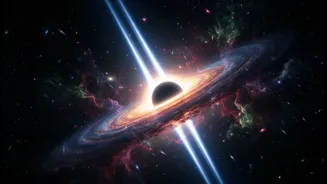
early universe—less than a billion years after the Big Bang—that are already millions or even billions of times the mass of our sun. According to the old rulebook of cosmology, this shouldn't be possible. Black holes were thought to start small, from the collapse of a single massive star, and grow slowly over cosmic history by feeding on gas and merging with other black holes. This new evidence suggests they skipped the awkward toddler phase and jumped straight to being giants.
Rewriting the Growth Playbook
The long-standing puzzle has been one of time. The traditional model, known as Eddington-limited accretion, puts a speed limit on how fast a black hole can eat. If it gobbles up gas too quickly, the surrounding material gets superheated and blasts away other potential 'food,' effectively making the black hole a messy eater that spoils its own dinner. This process meant it should take billions of years for a black hole to reach 'supermassive' status. Yet, new discoveries from telescopes like JWST and Euclid are finding these behemoths when the universe was just an infant, a mere 500 to 700 million years old. This has sent theorists back to the drawing board, forcing them to ask a fundamental question: did black holes grow impossibly fast, or were they just born big?
Heavy Seeds or Greedy Feeders?
Two main theories are now competing to explain this cosmic conundrum. The first is the "heavy seed" model. Instead of starting from a single star, this idea proposes that enormous clouds of gas in the early universe could have collapsed directly into a black hole, creating a 'seed' that was already tens of thousands of times the mass of the sun. This would give it a massive head start. Another theory suggests the rules of eating were different in the chaotic, dense environment of the early cosmos. Some models show that black holes could have undergone short, intense periods of "super-Eddington accretion," basically a feeding frenzy where they devoured material much faster than the supposed limit allows. Recent discoveries of these so-called "Little Red Dots"—compact, ancient galaxies—show black holes that appear far more massive than their host galaxies, suggesting their growth outpaced everything around them.
The Webb Telescope: A Time Machine
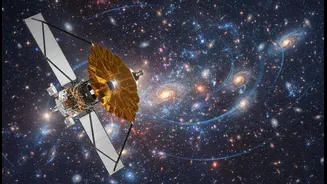
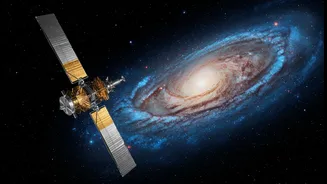
These revolutionary insights are possible thanks to the James Webb Space Telescope. Its unparalleled sensitivity to infrared light allows it to capture light that has been travelling for over 13 billion years, effectively looking back in time to the universe's dawn. Before Webb, many of these early, massive objects were suspected but couldn't be confirmed. Now, Webb's spectrographs can analyze the faint light from these primordial galaxies, revealing the tell-tale signs of a ravenous supermassive black hole at their center. It’s not just finding these objects; it’s weighing them and studying their environment, providing the crucial data needed to solve the mystery of their formation.
Why This Changes Everything
This isn't just an academic puzzle about distant objects. Supermassive black holes are thought to be the anchors of galaxies. They don't just sit there; their immense gravity and energy output shape how their host galaxy forms and evolves. Understanding how the first black holes formed is critical to understanding how the first galaxies, including the precursor to our own Milky Way, came into being. Did the galaxy build the black hole, or did a massive black hole form first and gather a galaxy around it? The evidence is now pointing towards the latter in some cases, a paradigm shift in our cosmic origin story. It suggests the universe was a far more dynamic and dramatic place in its infancy than we ever imagined.