







The Pacific's Climate Engine: El Niño
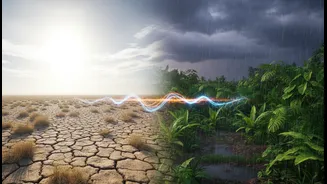
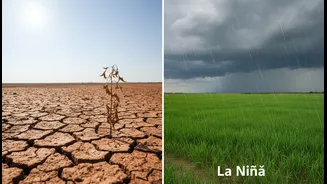
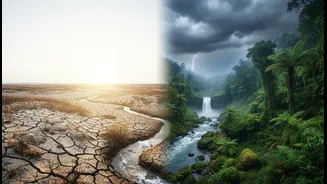
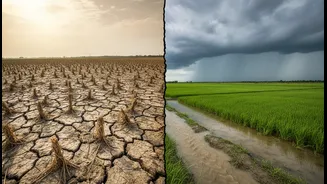
At the heart of this global connection is a recurring climate pattern known as the El Niño-Southern Oscillation (ENSO). This cycle involves a swing between warmer (El Niño) and cooler (La Niña) phases in the central and eastern equatorial Pacific Ocean
every two to seven years. During an El Niño event, the ocean surface in this region becomes unusually warm. This isn't just a minor temperature change; a strong El Niño can see sea surface temperatures rise more than 2°C above normal. This massive release of heat into the atmosphere acts like a giant stone thrown into a pond, creating ripples that spread across the globe and disrupt typical weather patterns. Conversely, La Niña is marked by cooler-than-average waters, which has its own set of opposite effects.
The Atmospheric Bridge to India
So, how does this Pacific warming reach India? The link is an atmospheric circulation pattern called the Walker Circulation. Normally, trade winds blow from east to west across the Pacific, piling up warm water in the western Pacific near Indonesia. This warm, moist air rises, creating clouds and rain there, then flows eastward at high altitudes, sinks over the cooler eastern Pacific, and flows back west along the surface, completing the loop. This circulation is directly connected to the winds that bring moisture to India for the monsoon. During an El Niño, this entire system weakens or even reverses. The rising warm air shifts eastward, away from the western Pacific. This change leads to sinking air—a high-pressure system—over South Asia, including India. This atmospheric setup suppresses cloud formation and weakens the entire monsoon circulation system.
A Weaker Monsoon and Drought Risk
The most direct and significant impact of a strong El Niño on India is a weaker summer monsoon. Historically, a majority of India's major droughts have coincided with El Niño years. The phenomenon is strongly linked with below-normal rainfall, which can be devastating for the country. When the monsoon is suppressed, large parts of central, western, and peninsular India can experience prolonged dry spells and reduced rainfall, threatening regions heavily dependent on rain-fed agriculture. For example, recent forecasts for July 2026, citing a strengthening El Niño, predicted below-normal rainfall after India had already experienced one of its driest Junes on record. However, the connection isn't a perfect one-to-one correlation. Not every El Niño year results in a drought. Other climate factors can sometimes counteract its effects.
Impact Beyond Rainfall: Agriculture and Economy
The consequences of a weakened, El Niño-affected monsoon ripple through India's entire economy. Agriculture, which contributes significantly to the nation's GDP, is the most vulnerable sector. Deficient rainfall reduces the production of crucial kharif (summer) crops like rice, leading to potential food shortages and rising food inflation. One study found that the average drop in rice production during a warm ENSO year was around 3.4 million tonnes. This impacts rural households severely, causing acute water scarcity and financial distress. The economic fallout can be substantial, with past warm ENSO years causing large financial losses in foodgrain production value. Beyond agriculture, lower water levels in reservoirs affect hydropower generation and urban water supplies, creating a cascade of challenges across multiple sectors.
A More Volatile Future
As the planet warms, the relationship between the Pacific and the Indian monsoon may become even more complex and volatile. Some research suggests that overall Indian Ocean warming is already modulating the effects of Pacific events. While El Niño's influence has historically been weaker over central India, it has reportedly strengthened over north India in recent decades. Climate models predict that continued warming is highly likely, which could intensify global rainfall pattern changes. This adds a layer of uncertainty, making accurate monsoon forecasting—which is already difficult—even more challenging and crucial. The potential for more frequent or intense El Niño events in a warmer world means India must bolster its climate resilience, from improving irrigation to developing climate-resilient farming practices, to better withstand these powerful global weather shocks.