


Early September: Epsilon-Perseid Meteor Shower
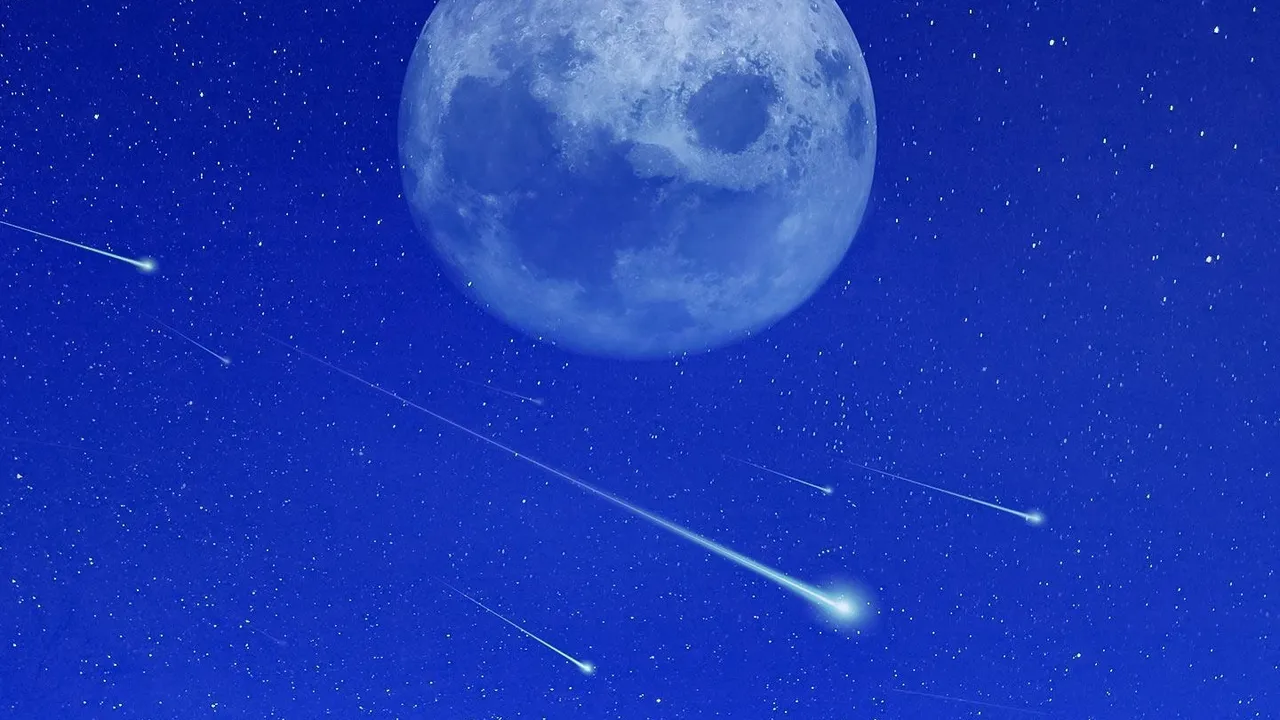
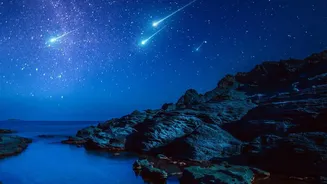
Kicking off the month is the Epsilon-Perseid meteor shower, active from September 5 to 21. The shower is expected to peak around September 9, offering a chance to see a handful of meteors—around four to five per hour under ideal conditions—streaking across
the sky. The good news for 2026 is that the peak occurs close to the new moon, meaning moonlight interference will be minimal, making it easier to spot the fainter meteors. For the best view, find a location far from city lights, let your eyes adjust to the darkness for about 30 minutes, and look towards the constellation Perseus. The best viewing time will be in the pre-dawn hours.
September 8: A Close Encounter with Jupiter
On the night of September 8, the Moon will have a close rendezvous with the largest planet in our solar system, Jupiter. The two celestial bodies will appear near each other in the sky, an event known as a conjunction. Jupiter, shining at a brilliant magnitude -2.0, will be easily visible to the naked eye. For skywatchers in India, this conjunction also results in a lunar occultation, where the Moon passes in front of and briefly hides Jupiter. This rare event is a fantastic opportunity for those with binoculars or a small telescope to get a closer look at the gas giant and its own moons.
September 23: The Autumnal Equinox
While not a visual spectacle in itself, September 23 marks a significant day on the astronomical calendar: the Autumnal Equinox. On this day, the Earth's axis is tilted neither toward nor away from the sun, resulting in nearly equal lengths of day and night across the globe. In the Northern Hemisphere, this event signals the official start of autumn. For India, the equinox will occur at 5:35 AM IST. It’s a moment of planetary balance before the nights begin to grow longer than the days, leading us into the winter season.
September 26: Neptune at Its Brightest
The distant ice giant Neptune reaches opposition on September 26. Opposition is the point in a planet's orbit when it is directly opposite the Sun in our sky, with Earth in between. This alignment means Neptune will be at its closest approach to Earth for the year, making it appear at its brightest and largest. While Neptune is too faint to be seen with the naked eye, this is the perfect time to spot it with a good pair of binoculars or a telescope. It will be visible for most of the night, appearing as a tiny, blue-tinged dot in the constellation Aquarius.
September 26: The Harvest Moon
The celestial highlight of September is undoubtedly the full Harvest Moon on September 26. This is the full moon that occurs closest to the Autumnal Equinox. Historically, its bright light helped farmers harvest their crops late into the evening. The moon officially reaches its peak illumination at 10:19 PM IST, but will appear full and brilliant on the nights of both September 26 and 27. A unique feature of the Harvest Moon is that it rises at nearly the same time for several consecutive evenings, providing a prolonged period of bright moonlight just after sunset.